Assembly Magazine logo
search
Ask ASSEMBLY AI
cart
facebook twitter linkedin youtube
  • Sign In
  • Create Account
  • Sign Out
  • My Account
Assembly Magazine logo
  • TRENDS
    • Ask ASSEMBLY AI
    • Trends
    • News
    • New Products
  • INDUSTRIES
    • Aerospace
    • Appliance
    • DFMA Assembly
    • Medical Devices
    • Green Manufacturing
    • Lean Manufacturing
    • Machinery Assembly
    • Electronics Assembly
    • Automotive
  • TECHNOLOGIES
    • Adhesives & Dispensing
    • Assembly Presses
    • Automated Assembly Systems
    • Manufacturing Management
    • Manufacturing Software
    • Motion Control
    • Screwdriving & Riveting
    • Robotics
    • Test & Inspection
    • Plastics & Metal Welding
    • Wire Processing
    • Workstations
  • AUTONOMOUS & ELECTRIC MOBILITY
    • AEM Magazine Archives
    • Autonomy
    • Electrification
    • Mobility Services
    • Assembly & Testing
    • AV/EM News
  • MEDIA
    • Ask ASSEMBLY AI
    • Podcasts
    • Assembly News Now
    • Assembly TV
    • Webinars
    • eBooks
  • EVENTS
    • Calendar
    • The ASSEMBLY Show
  • MORE
    • Exclusives >
      • Plant of the Year
      • Capital Spending
    • Buyers Guide >
      • Supplier Insights
    • Classifieds
    • Featured Products
    • Newsletters
    • Store
    • White Papers
    • Columns
    • Sponsor Insights
  • INFOCENTER
    • Assembly & Test Solutions
  • EMAGAZINE
    • eMagazine
    • Archive Issues
    • Advertise
    • Contact Us
    • Sign Up
TechnologiesAssembly Presses

Clinching for Galvanized Sheet Metal
By John Sprovieri
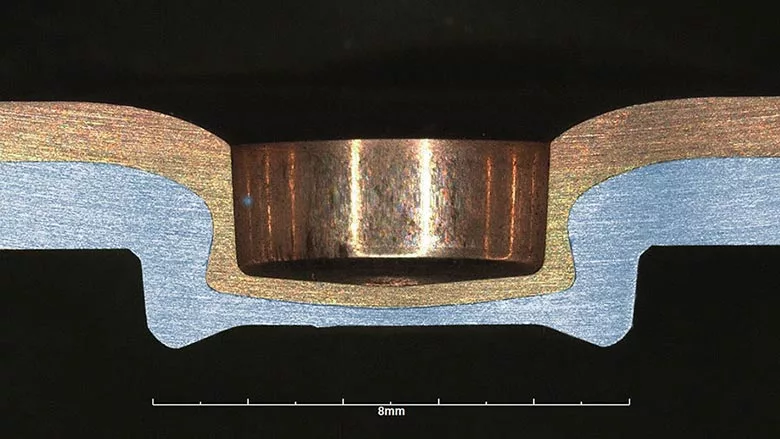
clinching aluminum and copper

Clinching can join dissimilar materials, such aluminum and copper, without creating an isolating intermetallic phase.
Photo courtesy Tox Pressotechnik

January 22, 2024

Galvanized steel sheets have a zinc coating to prevent corrosion. The coating is effective as long as it’s not breached. Unfortunately, one of the most common methods of sheet metal assembly—resistance spot welding—does just that. Clinching, on the other hand, does not. 

Clinching produces a round, button-like connection between two to four layers of sheet metal. The process can join metal sheets of different thicknesses. It can join dissimilar materials, such aluminum and copper, without creating an isolating intermetallic phase. The process can even be used on stainless steel.

Clinching will not damage anticorrosive coatings on the metal, and an adhesive or sealant can be located between the sheets. The minimum thickness for any one sheet in the assembly is 0.1 millimeter, and the entire stack can be up to 12 millimeters thick.

The process is primarily used in the manufacture of white goods, heating and ventilating components, and automotive parts.

The basis of each clinching system is the clinching tongs or clinching frame. The equipment includes an electromechanical servo drive or a hydropneumatic cylinder.
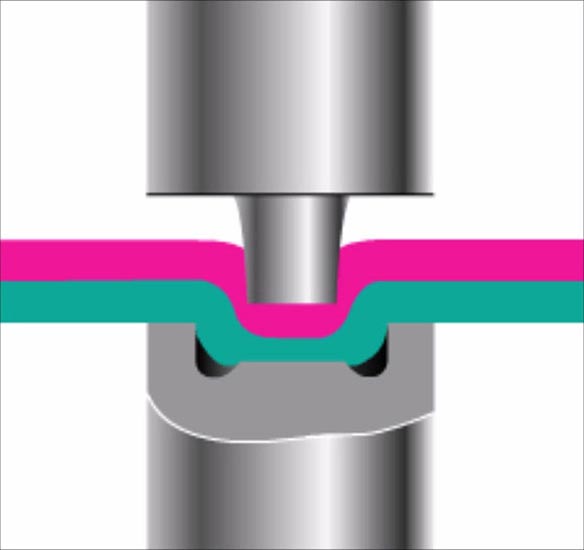
clinching

In clinching, a punch forces the layers of sheet metal into a die cavity. The pressure exerted by the press forces the punch-side metal to spread outwards within the die-side metal, creating a strong joint. Photo courtesy Tox Pressotechnik

The tools consist of a punch and a die that are designed specifically for the materials to be joined. There are two types of dies: solid, fixed-cavity dies, and dies with moving components. The punch forces the layers of sheet metal into the die cavity. The pressure exerted by the press forces the punch-side metal to spread outwards within the die-side metal. Joints can range from 1.5 to 26 millimeters in diameter.

The system can be complemented by force and displacement sensors for automatic control of the joining process and sequence parameters. Accessories include a spraying system for wetting the tools and materials, and a system to continuously check the condition of the die.

Looking for quick answers on assembly and manufacturing topics? Try Ask ASM, our new smart AI search tool. Ask ASM →


Ensuring a Successful Clinch

To get the most out of a joining process, the parts to be assembled should be designed with that process in mind. 

If materials of different thickness will be joined, it’s best to have the thicker material on the punch side. The thicker material must be at the top so that enough material can flow into the die cavity. Otherwise, the neck area will be fragile. The thicker material should not be more than twice the thickness of the thinner material. The combined thickness of the two plies should not exceed the combined maximum thickness recommended for the die.

By the same token, if one material is considerably harder than the other, the harder material should be on the punch side. If the softer material is on the punch side, the punch will pass through the softer material, instead of deforming it.

The strength of a clinched joint depends on four factors: material type, material thickness, clinch point size and surface condition. Generally, a joint in steel is stronger than one in aluminum. Also, a dry surface will provide a stronger joint than if it is oiled or greased.
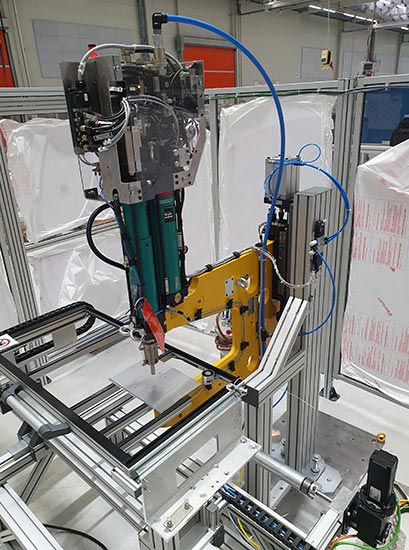
clinching galvanized sheet metal

Tox TZ machine tongs (yellow) and a 50-kilonewton press (green) ensure reliable clinching of galvanized sheet metal. Photo courtesy Tox Pressotechnik

Clinching requires open flanges with good access to both sides for the punch and die tooling. The flange width must be sufficient to accommodate the interlocking button produced during clinching. The clearance between the center of the joint and the outer edge of the flange should be 1.5 times the punch diameter. Also, the clearance between the joint and the inner edge of the flange must be large enough to allow the tooling access to make the joint.

Clinch joints should be spaced to avoid previously formed joints, as well as the immediate area around them. Clinching in or near prior joints may result in unsatisfactory joint appearance, excessive thinning of the bottom sheet and accelerated tool wear. Also, joints should not be placed so close together that the material distorts. However, there must be enough joints to ensure that the assembled component meets strength requirements. A minimum joint spacing of two to three times the button diameter is recommended.

Accurate fit-up and alignment help form good joints by ensuring that the sheets are drawn together between punch and die in the correct manner. Joints should be fully closed after the clamping stage. Poor fit-up and alignment are major contributors to inconsistent clinch quality.


Clinching in Action

One company that is taking advantage of clinching is MiniTec GmbH & Co. in Schönenberg-Kübelberg, Germany. 

MiniTec began in 1986 as a manufacturer of miniature linear guides for industrial machinery. Today, the company employs 420 people in 11 locations in Germany, France, Great Britain, Spain, Slovenia, China and the United States. Its offerings include conveyors, workstations, linear actuators, Cartesian motion systems, automated workcells, and even software for digital work instructions. 

Recently, MiniTec helped an electronics assembler design and build a system to clinch galvanized sheet metal. MiniTec provided a custom XY positioning table, while press manufacturer and clinching specialist Tox Pressotechnik provided a powerful press, tongs and tooling. A unique feature of the system is that operators do not need to change tools. They select a product to assemble from an HMI, insert the parts, and start the process.
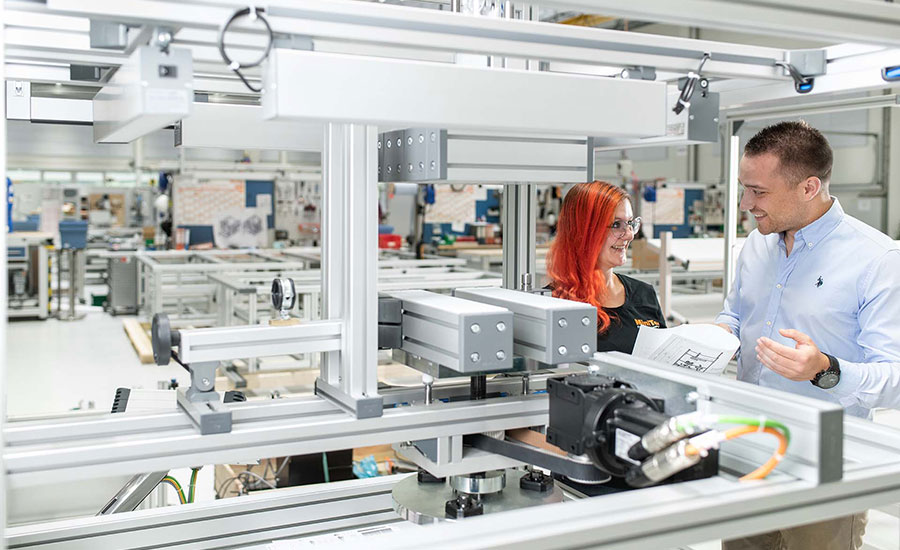
MiniTec manufacturing plant

MiniTec began in 1986 as a manufacturer of miniature linear guides for industrial machinery. Today, the company employs 420 people around the world. Photo courtesy MiniTec GmbH & Co.

“To join galvanized sheets, we recommend clinching,” says Marco Unger, sales representative for Tox Pressotechnik in Weingarten, Germany. “The zinc layer can run with the joining process, after galvanizing. Spot welding is not required, and there is no area of corrosion.”

The electronics assembler wanted to optimize its processes, and it specified the assembly sequences in detail: The operator places the components on an XY table, moves away from the monitored danger zone, and presses the start button. A PLC then runs through the joining program. First. the table positions the parts at the desired position. A compensating slide then moves the tongs upwards, so the die is aligned below the sheet. Next, the punch is aligned from the top and joins the sheets. The tongs are then moved down, and the table is positioned for the next joint.

“Two experts developed a complete system from one source,” says Frank Stattaus, account manager at MiniTec. 

For clinching, Tox supplied model TZ 05 machine tongs with compensation carriages and internal control. The TOX Powerpackage RZK provides the down-force. MiniTec acted as general contractor for the project, and developed an XY table with flexible base frame. A protective fence with a light curtain ensures safety. A controller monitors the various components and joints.

The complete system has paid off for the electronics assembler. Sheets can be clinched reliably and permanently, without creating any issues with corrosion later. Currently, 14 components of different sizes are joined on the system with a varying number of clinching points. The system can be programmed quickly and smoothly for new components.

For more information on sheet metal clinching, click here. 

For more information on automation components, click here.


ASSEMBLY ONLINE

For more information on presses and sheet-metal assembly, read these articles:
Optimizing Work Cells for Press-fit Assembly
Common Mistakes With Presses
Clinching for Sheet Metal Assembly

See more articles from our February 2024 issue!

KEYWORDS: assembly machine clinching mixed-material assembly sheet metal assembly

Share This Story

Looking for a reprint of this article?
From high-res PDFs to custom plaques, order your copy today!

John has been with ASSEMBLY magazine since February 1997. John was formerly with a national medical news magazine, and has written for Pathology Today and the Green Bay Press-Gazette. John holds a B.A. in journalism from Northwestern University, Medill School of Journalism.

Recommended Content

JOIN TODAY
To unlock your recommendations.

Already have an account? Sign In

  • Made in the U.S.A.

    Consumer Products Manufacturing: Made in the USA

    Supply chain lessons learned during the coronavirus...
    Automated Assembly Systems
    By: Austin Weber
  • Best Practices for Press-Fit Assembly

    Best Practices for Press-Fit Assembly

    In manufacturing, ironclad formulas for success are hard...
    Assembly Presses
    By: Jim Camillo
  • aem0523leader-tesla1.jpg

    Tesla Rethinks the Assembly Line

    Engineers at Tesla Inc. have developed a new process that...
    Automotive Assembly
    By: Austin Weber
Manage My Account
  • eMagazine Subscription
  • Assembly Newsletters
  • Online Registration
  • Subscription Customer Service
  • Manage My Preferences

More Videos

Sponsored Content

Sponsored Content is a special paid section where industry companies provide high quality, objective, non-commercial content around topics of interest to the ASSEMBLY audience. All Sponsored Content is supplied by the advertising company and any opinions expressed in this article are those of the author and not necessarily reflect the views of ASSEMBLY or its parent company, BNP Media. Interested in participating in our Sponsored Content section? Contact your local rep!

close
  • ultrasonic welding
    Sponsored bySonobond Ultrasonics

    Engineering Efficiency in High-Performance Assembly: How Ultrasonic Welding Enhances Throughput, Reliability and Quality

  • UV curing system
    Sponsored byDymax

    Why UV Intensity Alone Doesn’t Define Curing Performance

  • wooden pallets
    Sponsored byLEAN Manufacturing Products

    Eliminating Waste on the Shop Floor: Applying Lean Principles to Improve Manufacturing Efficiency

Popular Stories

ASSEMBLY News Now, episode-30: Volvo Redesigns EV Manufacturing

Volvo Redesigns EV Manufacturing

Boeing CEO Kelly Ortberg announces 1 billion investment

Boeing Plans $1 Billion Wichita Investment, Workforce Training Center

automated consumer goods assembly system

Best Practices for Cycle Time Optimization

Watch the latest episode of ANN now!

Events

July 24, 2025

From Shop Floor to CFO: How Manufacturers Are Closing the Loop Between Operations and Finance

On Demand Learn how manufacturers are bridging the gap between the shop floor and ERP systems to gain real-time visibility, streamline operations, and kick-start digital transformation—without waiting years.

Sponsored by:

PicoStratusGreen
July 30, 2025

Buffer Analysis and Design Fundamentals for Manufacturing Excellence

On Demand In this presentation, Dr. Herman Tang shares practical insights from his industry experience and research on buffer management in manufacturing operations.

View All Submit An Event

Poll

Difficult Assembly Processes

Which assembly process gives you the most difficulty?
View Results Poll Archive

Products

Manufacturing Cost Policy Deployment (MCPD) Profitability Scenarios: Systematic and Systemic Improvement of Manufacturing Costs

Manufacturing Cost Policy Deployment (MCPD) Profitability Scenarios: Systematic and Systemic Improvement of Manufacturing Costs

See More Products
Register for webinar - Modernizing Automotive Assembly: Why Upgrading Legacy MES is a Business Imperative

Related Articles

  • Clinching for Sheet Metal Assembly

    Clinching for Sheet Metal Assembly

    See More
  • Screwdriving for Sheet Metal Assembly

    Screwdriving for Sheet Metal Assembly

    See More

Related Products

See More Products
  • Kaizen Assembly: Designing, Constructing, and Managing a Lean Assembly Line

  • Product Design for Manufacture and Assembly, Third Edition

  • Joining of Plastics 3e Handbook for Designers and Engineers

See More Products

Events

View AllSubmit An Event
  • October 21, 2026

    FABTECH 2026

    Fabtech is North America’s largest metal forming, fabricating, welding and finishing event.
View AllSubmit An Event

Related Directories

  • TOX-Pressotechnik LLC

    TOX PRESSOTECHNIK is an innovative and global leader in press drive systems, sheet metal joining and assembly equipment. Our air/oil cylinders and servo presses offer solutions to the automotive, appliance, medical, aerospace and electronic industries. We invented the "clinching" - the joining of sheet metal by force and we developed machine drives such as our pneumohydraulic Powerpackages - which offer forces from 2 - 2000 kN. We have solutions for pressing, riviting, inserting elements and much more. Everything to help the metal producing industry to work efficiently and to meet customers needs.
  • BTM Company LLC

    Sheet Metal Joining Solutions BTM is a global leader in the design and engineering of specialty presses, production systems, precision tooling and work holding equipment. For over 50 years, BTM has provided customers with innovative equipment and tooling in the sheet metal industry.
  • ClinchPartner Inc.

    DistributorsAUSTRIATop Fasteners Pty.Ltd.www.topfasteners.com.auray_c@topfasteners.com.auINDIAAvlock Intl India91 22 258 234 04  www.avlock.co.inkoshi.thomas@avlock.co.inSOUTH AFRICAAvlock Intl PTY Ltd.27 11 748 7000  www.avlock.co.zainfo@avlock.co.zaVIETNAMTLC Modular Construction...
×

Never miss the latest news and trends driving the manufacturing industry

Stay in the know on the latest assembly trends.

JOIN TODAY!
  • RESOURCES
    • Advertise
    • Contact Us
    • Directories
    • Manufacturing Division
    • Store
    • Want More?
  • SIGN UP TODAY
    • Create Account
    • eMagazine
    • Newsletters
    • Customer Service
    • Manage Preferences
  • SERVICES
    • Marketing Services
    • Reprints
    • Market Research
    • List Rental
    • Survey/Respondent Access
  • STAY CONNECTED
    • LinkedIn
    • Facebook
    • Instagram
    • YouTube
    • X (Twitter)
  • PRIVACY
    • PRIVACY POLICY
    • TERMS & CONDITIONS
    • DO NOT SELL MY PERSONAL INFORMATION
    • PRIVACY REQUEST
    • ACCESSIBILITY

Copyright ©2026. All Rights Reserved BNP Media, Inc. and BNP Media II, LLC.

Design, CMS, Hosting & Web Development :: ePublishing