Assembly Magazine logo
search
Ask ASSEMBLY AI
cart
facebook twitter linkedin youtube
  • Sign In
  • Create Account
  • Sign Out
  • My Account
Assembly Magazine logo
  • TRENDS
    • Ask ASSEMBLY AI
    • Trends
    • News
    • New Products
  • INDUSTRIES
    • Aerospace
    • Appliance
    • DFMA Assembly
    • Medical Devices
    • Green Manufacturing
    • Lean Manufacturing
    • Machinery Assembly
    • Electronics Assembly
    • Automotive
  • TECHNOLOGIES
    • Adhesives & Dispensing
    • Assembly Presses
    • Automated Assembly Systems
    • Manufacturing Management
    • Manufacturing Software
    • Motion Control
    • Screwdriving & Riveting
    • Robotics
    • Test & Inspection
    • Plastics & Metal Welding
    • Wire Processing
    • Workstations
  • AUTONOMOUS & ELECTRIC MOBILITY
    • AEM Magazine Archives
    • Autonomy
    • Electrification
    • Mobility Services
    • Assembly & Testing
    • AV/EM News
  • MEDIA
    • Ask ASSEMBLY AI
    • Podcasts
    • Assembly News Now
    • Assembly TV
    • Webinars
    • eBooks
  • EVENTS
    • Calendar
    • The ASSEMBLY Show
  • MORE
    • Exclusives >
      • Plant of the Year
      • Capital Spending
    • Buyers Guide >
      • Supplier Insights
    • Classifieds
    • Featured Products
    • Newsletters
    • Store
    • White Papers
    • Columns
    • Sponsor Insights
  • INFOCENTER
    • Assembly & Test Solutions
  • EMAGAZINE
    • eMagazine
    • Archive Issues
    • Advertise
    • Contact Us
    • Sign Up
TechnologiesAppliance AssemblyAutomated Assembly SystemsRobotics Assembly

Robotic Screwdriving Boosts Throughput for Appliance Manufacturer
By Ulrike Götz
robotic screwdriving

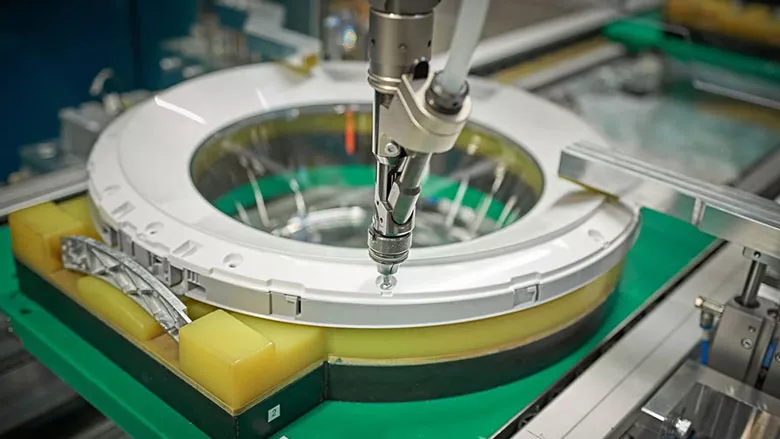
As the last fastener is being driven, the door begins moving out of the station, freeing up space and allowing the next door to enter, stop and position itself, so the robot can begin installing screws immediately, without having to wait.

Photo courtesy Kuka

April 10, 2025

In most assemblies that are joined with threaded fasteners, the cost of the fasteners is not as important as the cost of installing them. Automation is one way to control that cost.

Recently, an appliance manufacturer in Poland wanted to increase throughput and quality on the line that assembles doors for washing machines. Specifically, the process of installing screws to secure a glass window in the door had become a bottleneck. Engineers wanted to automate the process. 

Qbig, a systems integrator in Lodz, Poland, got the job. “Assisting people with robotics for a monotonous and tiring job such as screwdriving allows resources to be freed up and an employee to be used in more valuable task,” says Bartosz Luczak, co-owner of Qbig. “Robots increase the productivity of the plant by reducing the screwdriving cycle time.”

robotic screwdriving

Automating the screwdriving process freed up skilled labor to perform other tasks. Photo courtesy Kuka

The appliance manufacturer placed a high priority on cycle time. This was quite a challenge during the design phase of the screwdriving project. Qbig engineers considered several options.

One option would be to fixture multiple autofeed screwdriving spindles together and mount them to a linear slide. The door would stop below the screwdriving station; the slide would come down, and all the fasteners would be installed simultaneously. This option was ultimately rejected for its relative lack of flexibility.

Another option would be to mount a single autofeed screwdriver to a robot. The door would stop at the screwdriving station, and the robot would install each screw one at a time. This option was more flexible, but stopping the door meant the station couldn’t meet the cycle time requirement.

It was then that Qbig engineers came up with a unique way to shave a few seconds off the cycle time: screwdriving “on the fly.” The door would still stop at the station, at least initially. However, as the last fastener is being driven, the door begins moving out of the station, freeing up space and allowing the next door to enter, stop and position itself, so the robot can begin installing screws immediately, without having to wait.

Looking for quick answers on assembly and manufacturing topics? Try Ask ASM, our new smart AI search tool. Ask ASM →
robotic screwdriving

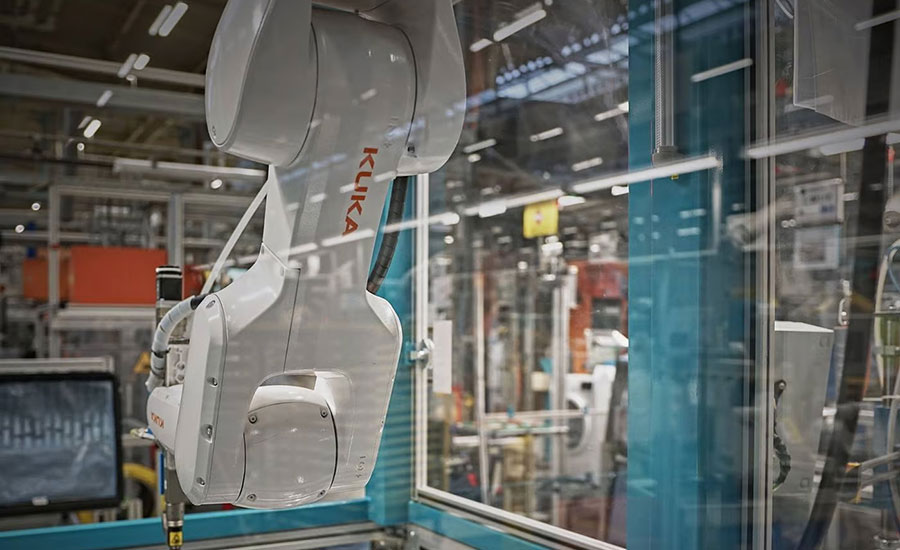
For a conveyor-tracking application, a six-axis robot was the best option. Photo courtesy Kuka

For this design, a six-axis robot was the best option. Qbig engineers chose the KR Agilus robot from Kuka to do the job. The KR Agilus is a compact six-axis robot for particularly high working speeds. Maximum payload ranges from 6 to 11 kilograms, and maximum reach ranges from 706 to 1,101 millimeters. Positional repeatability ranges from ±0.02 to ±0.03 millimeter.

The robot can be mounted to the floor, ceiling or wall. It is ideal for confined spaces thanks to its integrated energy supply and control technology. Safe robot functionality enables innovative automation concepts. The robot is protected against electrostatic discharge, and variants are available for clean rooms; hygienic or wet environments; and potentially explosive environments.

Thanks to its lifetime lubrication, the robot never needs a change of lubricant in the gear units and has minimal maintenance requirements. 

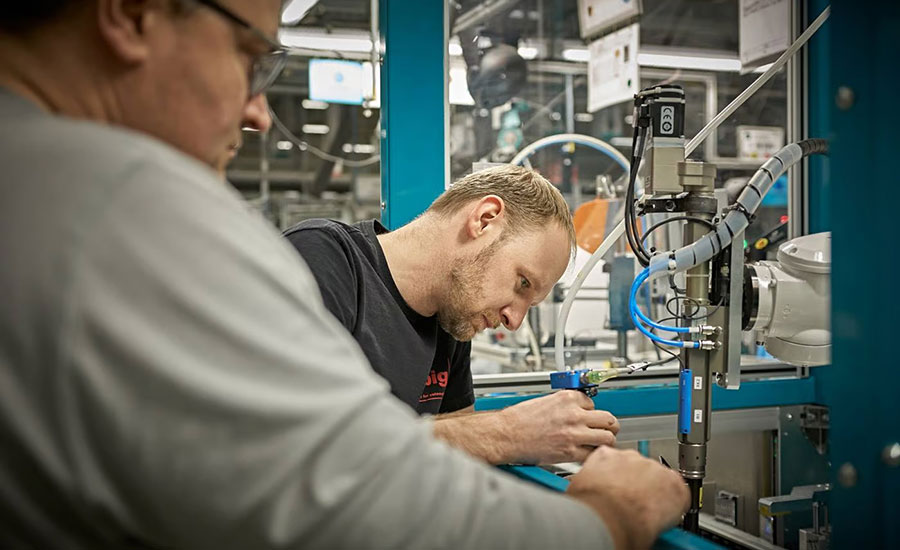
For screwdriving on the fly to work, Qbig engineers needed a way to precisely determine and control the position of the moving components to ensure the fastener is installed correctly. Kuka’s ConveyorTech software solved that problem. The software coordinates interaction between the robot and conveyor. The software automatically adjusts the robot’s movements to the linear motion of the assembly line.
robotic screwdriving

ConveyorTech software automatically adjusts the robot’s movements to the linear motion of the assembly line. Photo courtesy Kuka

The software is simple to program and fast to commission. The software makes it possible to work parallel to the progress of the conveyor. The software works with belt conveyors or with automated guided vehicles. It also offers the option of multiple tracking. Up to five conveyors can be monitored without difficulty. Both linear and circular conveyors can be monitored in mixed operation. In addition, up to 1,024 components per conveyor can be managed in memory.

“We didn’t realize that there was such an application as ConveyorTech,” says Luczak. “We knew that it was possible to track and control packages on the line, for example, but we were not sure if this tracking was accurate enough to be used with a screwdriving application. At first, we had doubts, but in the end the software solved our problem.”

Thanks to conveyor tracking and robotic screwdriving, Qbig was able to meet the appliance manufacturer’s cycle time requirement.


For more information on robotics, read these articles:
Robots Automate Tough Automotive Assembly Project
Vision-Guided Robots Process Hydraulic Components
Kuka Introduces New High-Payload SCARA

KEYWORDS: National Robotics Week robotic screwdriving

Share This Story

Looking for a reprint of this article?
From high-res PDFs to custom plaques, order your copy today!

Ulrike Götz // Technology Spokesperson // Augsburg, Germany

Recommended Content

JOIN TODAY
To unlock your recommendations.

Already have an account? Sign In

  • Made in the U.S.A.

    Consumer Products Manufacturing: Made in the USA

    Supply chain lessons learned during the coronavirus...
    Automated Assembly Systems
    By: Austin Weber
  • Best Practices for Press-Fit Assembly

    Best Practices for Press-Fit Assembly

    In manufacturing, ironclad formulas for success are hard...
    Assembly Presses
    By: Jim Camillo
  • aem0523leader-tesla1.jpg

    Tesla Rethinks the Assembly Line

    Engineers at Tesla Inc. have developed a new process that...
    Electrification
    By: Austin Weber
Manage My Account
  • eMagazine Subscription
  • Assembly Newsletters
  • Online Registration
  • Subscription Customer Service
  • Manage My Preferences

More Videos

Sponsored Content

Sponsored Content is a special paid section where industry companies provide high quality, objective, non-commercial content around topics of interest to the ASSEMBLY audience. All Sponsored Content is supplied by the advertising company and any opinions expressed in this article are those of the author and not necessarily reflect the views of ASSEMBLY or its parent company, BNP Media. Interested in participating in our Sponsored Content section? Contact your local rep!

close
  • ultrasonic welding
    Sponsored bySonobond Ultrasonics

    Engineering Efficiency in High-Performance Assembly: How Ultrasonic Welding Enhances Throughput, Reliability and Quality

  • UV curing system
    Sponsored byDymax

    Why UV Intensity Alone Doesn’t Define Curing Performance

  • wooden pallets
    Sponsored byLEAN Manufacturing Products

    Eliminating Waste on the Shop Floor: Applying Lean Principles to Improve Manufacturing Efficiency

Popular Stories

Ferrari

Ferrari Unveils Four-Door EV

ASSEMBLY News Now, episode-30: Volvo Redesigns EV Manufacturing

Volvo Redesigns EV Manufacturing

automated consumer goods assembly system

Best Practices for Cycle Time Optimization

Watch the latest episode of ANN now!

Events

July 24, 2025

From Shop Floor to CFO: How Manufacturers Are Closing the Loop Between Operations and Finance

On Demand Learn how manufacturers are bridging the gap between the shop floor and ERP systems to gain real-time visibility, streamline operations, and kick-start digital transformation—without waiting years.

Sponsored by:

PicoStratusGreen
July 30, 2025

Buffer Analysis and Design Fundamentals for Manufacturing Excellence

On Demand In this presentation, Dr. Herman Tang shares practical insights from his industry experience and research on buffer management in manufacturing operations.

View All Submit An Event

Poll

Difficult Assembly Processes

Which assembly process gives you the most difficulty?
View Results Poll Archive

Products

Manufacturing Cost Policy Deployment (MCPD) Profitability Scenarios: Systematic and Systemic Improvement of Manufacturing Costs

Manufacturing Cost Policy Deployment (MCPD) Profitability Scenarios: Systematic and Systemic Improvement of Manufacturing Costs

See More Products
Register for webinar - Modernizing Automotive Assembly: Why Upgrading Legacy MES is a Business Imperative

Related Articles

  • Chinese Appliance Manufacturer Embraces Robotic Assembly

    See More
  • Sealing Crimped Contacts Avoids Corrosion

    German Appliance Manufacturer to Open US Assembly Plant

    See More
  • Canadian Appliance Manufacturer to Make Ventilators

    See More

Related Products

See More Products
  • manu.jpg

    Manufacturing System Throughput Excellence: Analysis, Improvement, and Design

  • Robotic Micro-Assembly

  • Product Design for Manufacture and Assembly, Third Edition

See More Products

Events

View AllSubmit An Event
  • January 28, 2026

    Introduction to Robotic Screwdriving

    On Demand In this presentation, you will learn options for robotic screwdriving, how to justify the investment, and tips and tricks for implementing the technology.
View AllSubmit An Event
×

Never miss the latest news and trends driving the manufacturing industry

Stay in the know on the latest assembly trends.

JOIN TODAY!
  • RESOURCES
    • Advertise
    • Contact Us
    • Directories
    • Manufacturing Division
    • Store
    • Want More?
  • SIGN UP TODAY
    • Create Account
    • eMagazine
    • Newsletters
    • Customer Service
    • Manage Preferences
  • SERVICES
    • Marketing Services
    • Reprints
    • Market Research
    • List Rental
    • Survey/Respondent Access
  • STAY CONNECTED
    • LinkedIn
    • Facebook
    • Instagram
    • YouTube
    • X (Twitter)
  • PRIVACY
    • PRIVACY POLICY
    • TERMS & CONDITIONS
    • DO NOT SELL MY PERSONAL INFORMATION
    • PRIVACY REQUEST
    • ACCESSIBILITY

Copyright ©2026. All Rights Reserved BNP Media, Inc. and BNP Media II, LLC.

Design, CMS, Hosting & Web Development :: ePublishing