Assembly Magazine logo
search
Ask ASSEMBLY AI
cart
facebook twitter linkedin youtube
  • Sign In
  • Create Account
  • Sign Out
  • My Account
Assembly Magazine logo
  • TRENDS
    • Ask ASSEMBLY AI
    • Trends
    • News
    • New Products
  • INDUSTRIES
    • Aerospace
    • Appliance
    • DFMA Assembly
    • Medical Devices
    • Green Manufacturing
    • Lean Manufacturing
    • Machinery Assembly
    • Electronics Assembly
    • Automotive
  • TECHNOLOGIES
    • Adhesives & Dispensing
    • Assembly Presses
    • Automated Assembly Systems
    • Manufacturing Management
    • Manufacturing Software
    • Motion Control
    • Screwdriving & Riveting
    • Robotics
    • Test & Inspection
    • Plastics & Metal Welding
    • Wire Processing
    • Workstations
  • AUTONOMOUS & ELECTRIC MOBILITY
    • AEM Magazine Archives
    • Autonomy
    • Electrification
    • Mobility Services
    • Assembly & Testing
    • AV/EM News
  • MEDIA
    • Ask ASSEMBLY AI
    • Podcasts
    • Assembly News Now
    • Assembly TV
    • Webinars
    • eBooks
  • EVENTS
    • Calendar
    • The ASSEMBLY Show
  • MORE
    • Exclusives >
      • Plant of the Year
      • Capital Spending
    • Buyers Guide >
      • Supplier Insights
    • Classifieds
    • Featured Products
    • Newsletters
    • Store
    • White Papers
    • Columns
    • Sponsor Insights
  • INFOCENTER
    • Assembly & Test Solutions
  • EMAGAZINE
    • eMagazine
    • Archive Issues
    • Advertise
    • Contact Us
    • Sign Up
TechnologiesAutomotive AssemblyElectronics AssemblyAutomated Assembly SystemsRobotics Assembly

Robots Assemble Automotive Sensors

By John Sprovieri
automated production system
Photo courtesy Denso Robotics

Erwin Quarder Systemtechnik designed and built a fully automated production system that begins with the molding of the parts and ends with finished sensors. 

August 8, 2025

A typical vehicle contains 60 to 100 sensors. Specialty models, or higher-end cars with more safety and convenience features, can have more than 200 sensors. 

Some sensors, like the oxygen sensor or the mass air flow sensor, keep the engine running efficiently. Others, like the air bag sensor or tire pressure sensor, are safety related. Still others, such as temperature or light sensors, are related to driver comfort or convenience.

Given their small size, high production volumes and exacting precision requirements, these sensors are not assembled manually. Automation is the only way to go.

An important and challenging part of the assembly process is attaching the sensor to a carrier. The carrier helps to integrate the sensor into various systems, whether it’s for physical mounting, environmental protection, or network connectivity. 

The sensor is often attached to the carrier using a wave-soldering process. Ideally, the height of the solder wave should be consistent. However, molten solder, like any liquid, can be unpredictable. Slight variations in height are unavoidable, and that means the height of each carrier assembly as it passes over and through the wave must be adjusted on the fly.

This was the challenge faced by manufacturing conglomerate Erwin Quarder Systemtechnik GmbH & Co. in Espelkamp, Germany, about 60 miles west of Hanover. 

Founded in 1971 by engineer Erwin Quarder, the company began as a manufacturer of tools for stamping and injection molding. Over time, the company began adding complementary services. As long as we’re making the mold, management reasoned, why not make the parts, as well? And, if we’re making the parts, why not assemble them? The company’s automation division grew out of the need to make equipment to do just that.

Looking for quick answers on assembly and manufacturing topics? Try Ask ASM, our new smart AI search tool. Ask ASM →

For the automotive sensor, Erwin Quarder Systemtechnik designed and built a fully automated production system that begins with the molding of the parts and ends with finished sensors. The assembly line incorporates multiple processes, including insertion of the sensor onto a carrier, fluxing and soldering, test and inspection, and finally placing the finished assemblies into trays. 
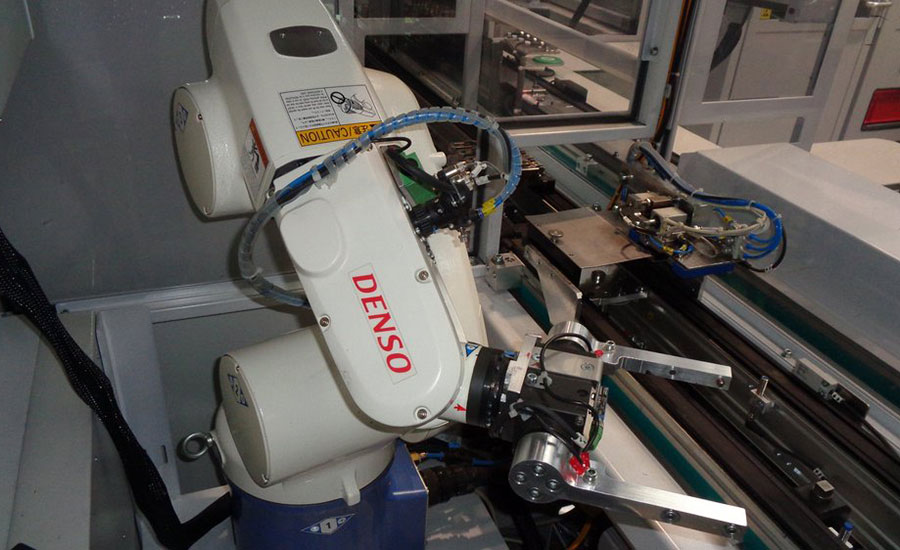
 

robotic soldering

Photo courtesy Denso Robotics

Robot Adjusts on the Fly

Six-axis robots from Denso Robotics are the workhorses of the system. For example, a Denso VS 6556G robot plays a key role in the wave-soldering process. The robot is equipped to carry a custom soldering fixture that holds four sensor assemblies. In a precise motion, the robot must pass the fixture over and through the solder wave.

The task is more difficult than it sounds. Although the height of the solder wave is set at 4 millimeters, the actual height of the wave can deviate by as much as 1 millimeter. As a result, if the height of the fixture remains constant, some assemblies could get too little solder and some too much.

To prevent that from happening, a sensor continually monitors the height of the solder wave and reports that value to the robot controller. This enables the robot to adjust to the position of the fixture on the fly so it’s always at the ideal height for soldering.

The soldering process must be as precise as possible, to prevent damaging the sensors or deforming the carriers. Once the soldering process has been completed—it takes 30 to 32 seconds per fixture—the robot places the fixture back on the assembly line for quality control. 

At the end of the line, a VS 060 robot picks and places the finished sensors into trays for shipping to an automotive OEM.

The robots are fully integrated into the system via a Profibus network. All figures for the soldering process are being transmitted as integer variables, including soldering angle, soldering height, duration, speed and time. The robots were programmed in WinCaps using PacScript. 

Linked by an external VPN connection, the Ethernet-based control can be accessed by engineers on a touch screen control panel. Here, engineers can individually adjust all parameters of the soldering process, such as speed, path, duration and angle. This is a big advantage when assembly of different sensor models is required. It enables engineers to quickly and easily modify the soldering process without having to go through the time and effort of re-programming the base settings.

Quarder has been using Denso robots since 2013. The company chose the VS 6556G due to its six axes of motion, since the soldering process requires mobility and flexibility. The robot’s 7-kilogram payload capacity was important, since a fully loaded fixture weighs approximately 2 kilograms. The robot’s 0.49-second cycle time and its repeatability of ±0.02 millimeter were crucial, as well. 

Working in a three-shift operation, the system assembles 10,800 sensors every 24 hours. The error rate of the soldering process is just 1 percent.

For more information on robots, visit www.densorobotics.com. For more information on assembly automation, visit www.quarder.de. 

Learn about new products for automation

ACE Controls Streamlines Automation Efficiency

Powerful Automation: item Conveyor Belts

MPXS Series Micro Vacuum Pumps

Powerful Automation: item Conveyor Belts

Boulware Systems Keep Wood Trash Out of Landfills

We are Linear Motion People

For more information on assembly robots, read these articles:

Is Robotic Screwdriving Right for You?
Robots Improve Quality and Lower Costs
Pint-sized Assemblers

KEYWORDS: factory automation flexible assembly soldering

Share This Story

Looking for a reprint of this article?
From high-res PDFs to custom plaques, order your copy today!

John has been with ASSEMBLY magazine since February 1997. John was formerly with a national medical news magazine, and has written for Pathology Today and the Green Bay Press-Gazette. John holds a B.A. in journalism from Northwestern University, Medill School of Journalism.

Recommended Content

JOIN TODAY
To unlock your recommendations.

Already have an account? Sign In

  • Made in the U.S.A.

    Consumer Products Manufacturing: Made in the USA

    Supply chain lessons learned during the coronavirus...
    Automated Assembly Systems
    By: Austin Weber
  • Best Practices for Press-Fit Assembly

    Best Practices for Press-Fit Assembly

    In manufacturing, ironclad formulas for success are hard...
    Assembly Presses
    By: Jim Camillo
  • aem0523leader-tesla1.jpg

    Tesla Rethinks the Assembly Line

    Engineers at Tesla Inc. have developed a new process that...
    Industries
    By: Austin Weber
Manage My Account
  • eMagazine Subscription
  • Assembly Newsletters
  • Online Registration
  • Subscription Customer Service
  • Manage My Preferences

More Videos

Sponsored Content

Sponsored Content is a special paid section where industry companies provide high quality, objective, non-commercial content around topics of interest to the ASSEMBLY audience. All Sponsored Content is supplied by the advertising company and any opinions expressed in this article are those of the author and not necessarily reflect the views of ASSEMBLY or its parent company, BNP Media. Interested in participating in our Sponsored Content section? Contact your local rep!

close
  • ultrasonic welding
    Sponsored bySonobond Ultrasonics

    Engineering Efficiency in High-Performance Assembly: How Ultrasonic Welding Enhances Throughput, Reliability and Quality

  • UV curing system
    Sponsored byDymax

    Why UV Intensity Alone Doesn’t Define Curing Performance

  • wooden pallets
    Sponsored byLEAN Manufacturing Products

    Eliminating Waste on the Shop Floor: Applying Lean Principles to Improve Manufacturing Efficiency

Popular Stories

Ferrari

Ferrari Unveils Four-Door EV

ASSEMBLY News Now, episode-30: Volvo Redesigns EV Manufacturing

Volvo Redesigns EV Manufacturing

automated consumer goods assembly system

Best Practices for Cycle Time Optimization

Watch the latest episode of ANN now!

Events

July 24, 2025

From Shop Floor to CFO: How Manufacturers Are Closing the Loop Between Operations and Finance

On Demand Learn how manufacturers are bridging the gap between the shop floor and ERP systems to gain real-time visibility, streamline operations, and kick-start digital transformation—without waiting years.

Sponsored by:

PicoStratusGreen
July 30, 2025

Buffer Analysis and Design Fundamentals for Manufacturing Excellence

On Demand In this presentation, Dr. Herman Tang shares practical insights from his industry experience and research on buffer management in manufacturing operations.

View All Submit An Event

Poll

Difficult Assembly Processes

Which assembly process gives you the most difficulty?
View Results Poll Archive

Products

Manufacturing Cost Policy Deployment (MCPD) Profitability Scenarios: Systematic and Systemic Improvement of Manufacturing Costs

Manufacturing Cost Policy Deployment (MCPD) Profitability Scenarios: Systematic and Systemic Improvement of Manufacturing Costs

See More Products
Register for webinar - Modernizing Automotive Assembly: Why Upgrading Legacy MES is a Business Imperative

Related Articles

  • five-station automated assembly system

    SCARA Robots Assemble Automotive Component

    See More
  • asb0123robot1.jpg

    Robots Assemble Pressure Sensors

    See More
  • Automotive Sensors Market to Increase 7.7 Percent Annually

    See More

Related Products

See More Products
  • The Automotive Body Manufacturing Systems and Processes

See More Products

Related Directories

  • HTM Sensors

  • VOXX Automotive

×

Never miss the latest news and trends driving the manufacturing industry

Stay in the know on the latest assembly trends.

JOIN TODAY!
  • RESOURCES
    • Advertise
    • Contact Us
    • Directories
    • Manufacturing Division
    • Store
    • Want More?
  • SIGN UP TODAY
    • Create Account
    • eMagazine
    • Newsletters
    • Customer Service
    • Manage Preferences
  • SERVICES
    • Marketing Services
    • Reprints
    • Market Research
    • List Rental
    • Survey/Respondent Access
  • STAY CONNECTED
    • LinkedIn
    • Facebook
    • Instagram
    • YouTube
    • X (Twitter)
  • PRIVACY
    • PRIVACY POLICY
    • TERMS & CONDITIONS
    • DO NOT SELL MY PERSONAL INFORMATION
    • PRIVACY REQUEST
    • ACCESSIBILITY

Copyright ©2026. All Rights Reserved BNP Media, Inc. and BNP Media II, LLC.

Design, CMS, Hosting & Web Development :: ePublishing