Sensors Measure Strength of Composite Wings
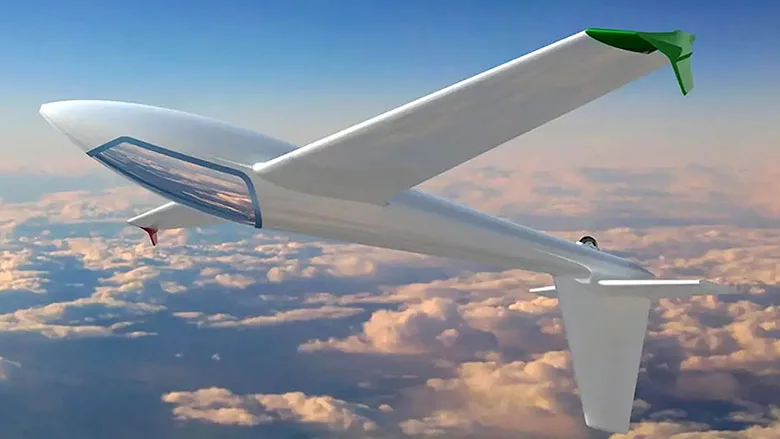
Akaflieg München’s latest project is the Mü-32 “Reißmeister” aerobatic glider.
In the spring of 1891, 43-year-old German engineer Otto Lilienthal strapped himself into a glider of his own design and jumped from the slope of a sand pit on the outskirts of Berlin. Made from willow rods and cotton fabric, the glider flew 80 feet.
The following year, he built more sophisticated models that allowed him to glide as far as 1,150 feet. The gliders were designed so that he could control their direction by shifting his body weight.
Over the next four years, Lilienthal continued to refine his design and took more than 2,000 flights by the time of his death—in a gliding accident—on Aug. 9, 1896. Today, he is remembered as the first successful aviator in history, and his research is credited with inspiring the Wright brothers and other aviation pioneers.
Although gliding has long since been overshadowed by powered flight, the sport remains a tradition in Germany. This is due, in part, to “akafliegs”—an abbreviation for “akademische fliegergruppe,” or academic flying clubs. Affiliated with universities, akafliegs are dedicated to the design and construction of airplanes, especially gliders, and to scientific research on flight. Through these clubs, students gain invaluable experience in aircraft design and maintenance. As a bonus, they can obtain a pilot’s license for gliders at a discount and participate in flying competitions.
One of the oldest clubs is Akaflieg München, an affiliate of the Technical University of Munich. Founded in 1924, when motorized flight was prohibited in Germany following the Treaty of Versailles, Akaflieg München has around 40 members, including students and alumni. From an airfield in Königsdorf, roughly 12 miles south of Munich, members take off on one-way or round-trip flights around the Bavarian capital as well as to the nearby Alps, a particularly spectacular location.
Many of the aircraft built by Akaflieg München have set benchmarks and are still being flown today. These include the motorized Mü-30 “Schlacro” aerobatic plane and the Mü-28, one of the fastest gliders of all time. With a maximum speed of 380 kilometers per hour, the Mü-28 made its maiden flight in 1983.
Major Hurdle for a New Glider
Joscha Löwe has been a member of Akaflieg München since 2018, making him an “old hand.” He started out studying mechanical engineering before eventually switching majors to medicine. Nevertheless, he still finds the time to work on the club’s latest project, the Mü-32 “Reißmeister,” at times even taking the lead on the project.
Looking for quick answers on assembly and manufacturing topics? Try Ask ASM, our new smart AI search tool. Ask ASM
“With the Mü-32, we want to build an aerobatic glider that improves on the Mü-28. In particular, we want to achieve better performance during stalling, we want to increase crash safety, and we want to install an automatic plain flap,” Löwe says.
The goal is to design a glider that can withstand loads of up to 10 g and speeds of up to 320 kilometers per hour.
To receive approval from the Luftfahrt-Bundesamt, Germany’s civil aviation authority, the club will have to clear major hurdles to prove that the aircraft can withstand those anticipated loads many times over.
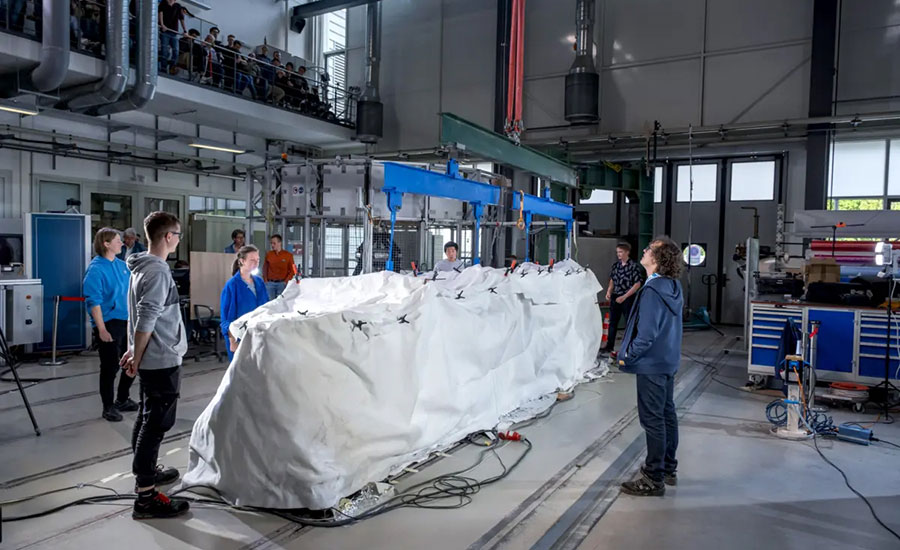
Static load testing involves applying a gradually increasing load to the wing until it fails. Photo courtesy Kistler Group
To do that, the club will have to perform destructive testing of the glider’s sophisticated carbon-fiber wings, which are made mostly by hand at the university’s Laboratory for Product Development and Lightweight Design in nearby Garching, Germany.
Destructive testing involves subjecting the wings to extreme conditions and forces to determine their breaking point and failure modes.
Several types of tests must be done. For example, static load testing involves applying a gradually increasing load to the wing until it fails. This test helps determine the wing’s strength and ability to withstand aerodynamic forces. Fatigue testing involves repeatedly applying loads to the wing to simulate the stresses it will experience during flight. This helps identify potential weaknesses and failure points due to repeated stress cycles. During the tests, the wings will be loaded in a controlled manner at a prescribed temperature of 54°C.
Sensors and test instruments from the Kistler Group play a key role in this testing.
“In addition to high-speed cameras, we use 35 strain-gauge sensors, as well as rope displacement transducers and temperature sensors,” explains Clemens Lippmann, who is pursuing a master’s degree in astrophysics and is close to obtaining his glider pilot’s license. “All the sensors are connected to Kistler’s data acquisition system, KiDAQ, which is precisely tailored to our tests.”
A key sensor for the tests is the Model 9377D triaxial piezoelectric load cell for measuring all forces on three orthogonal components acting in an arbitrary direction. The cell is mounted under preload between two plates and measures both tensile and compression forces in all directions. The simple and vibration-resistant design of the cell is very rigid, resulting in a high natural frequency—a requirement for highly dynamic force measurements. After installation, the cell is ready for use without recalibration.
With a measuring range of up to 150 kilonewtons, the cell is installed on the tip of the load suspension system, between steel girders holding the wing and the crane.
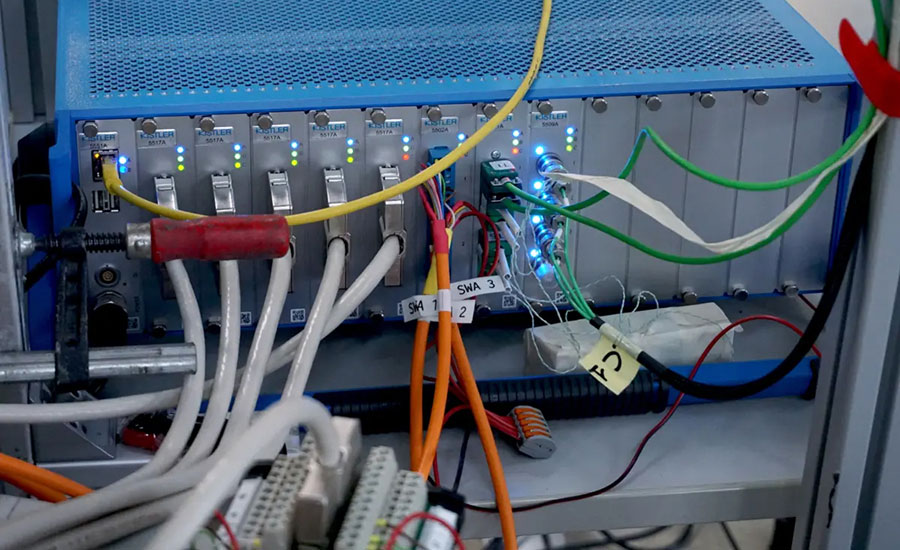
The data acquisition system pulls in data from multiple sensors, including piezoelectric force sensors, strain-gauge sensors and thermocouples. Photo courtesy Kistler Group
The KiDAQ is a general-purpose data acquisition system to measure more than 20 different analog and digital signal types. A wide selection of signal conditioning and data acquisition modules enables engineers to equip the system to match their specific testing requirements.
Thanks to the modular design of the KiDAQ, all the sensors used for wing testing can be connected to the system regardless of manufacturer. The system automatically synchronizes incoming data via the precision time protocol.
Akaflieg München first worked with Kistler in 2021 through the Münster-based company Crash Test Service GmbH, one of Kistler’s partners in the field of crash testing. At that time, Akaflieg München was developing an innovative crash-resistant cockpit for gliders and, in particular, the future Mü-32. The final crash test used a dummy instrumented with KiDAQ and various Kistler sensors.
During the crash tests, Lippmann began using Kistler’s jBEAM software, which greatly simplifies the evaluation of measurement data.
“With jBEAM, Kistler provided exactly what we needed while also saving us a great deal of tedious programming work in Python,” he says.
The software supports the import of multiple measurement file formats, as well as multimedia formats to combine measurement data with images, audio and video. Analysis functions range from simple arithmetic operations, curve analysis and FFT calculations to matrix operations, signal filters and statistics. To visualize the data, engineers can create forms and tables or 2D and 3D graphs. Control elements let engineers create interactive visualizations and reports.

An overhead crane gradually applies force to the wing. Photo courtesy Kistler Group
Why Did the Wing Break so Quickly?
On April 18, 2024, after more than a year of preparation, the time had finally come: Live on the internet and in front of many interested engineers, students and club alumni, the destructive wing test was expected to go off without a hitch. The wing was heated to 54°C and then gradually subjected to an increasing load.
Unfortunately, the wing broke after just a few seconds, far below the targeted maximum load.
“To this day, we do not know for sure why it happened,” laments Löwe. “There was no single factor that we could determine to be the cause. The most likely answer is that the test setup was not sufficient and that we will need to use more load-shears to properly distribute the force or optimize the bend line.
“We are still analyzing the data from all of the sensors and cameras using the jBEAM software, which is extremely powerful and practical in terms of evaluation, especially when it comes to importing and exporting data.”
Once the causes have been determined and an alternative design developed, it will be time for Akaflieg München to start the testing process all over again. Without a successful destructive wing test, the wings cannot be approved and the glider will never fly.
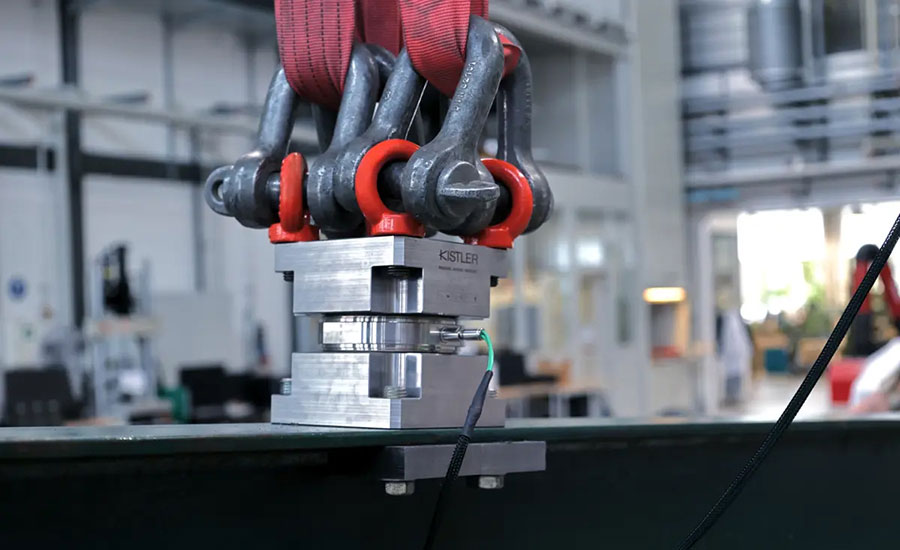
The Model 9377D piezoelectric force sensor measures the load applied to the wing dynamically. Photo courtesy Kistler Group
For now, the students are back at square one. New wings will need to be designed and made, and a new testing process will need to be developed. The next destructive test might not occur until 2028 or even 2030.
When the time comes, however, the team plans to use additional force measurement technology from Kistler. They may also use an optical measuring system to precisely track the deformation on the wing.
“The measurement technology from Kistler has very much proved its worth, so much so that we will definitely be using it again in the future,” says Löwe. “Eventually, we hope to use additional sensor technology for the Mü-32 flight tests, but that’s a long way off.”
For more information on force measurement technology, visit www.kistler.com.
For more information on force sensors, read these articles:
New Process Monitoring System Offers Flexibility
Robotic Work Cell Clinches Sheet Metal Parts
Swiss Engineers Develop Electric Airplanes
Looking for a reprint of this article?
From high-res PDFs to custom plaques, order your copy today!