2025 Assembly Plant of the Year: Deere Leaps Ahead With 5G Connectivity
October 1, 2025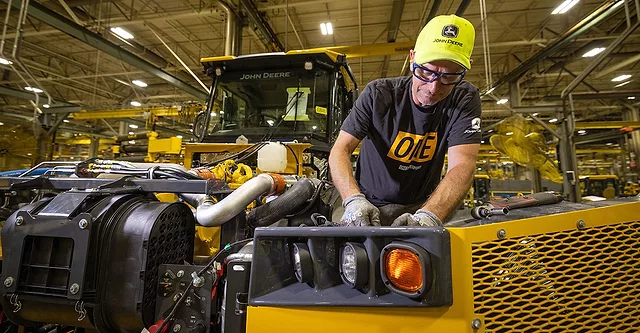
2025 Assembly Plant of the Year: Deere Leaps Ahead With 5G Connectivity
October 1, 2025
Deere & Co. is one of the oldest manufacturers in the United States. While the company traces its roots back to the early 19th century (see sidebar below), it’s miles ahead of many companies when it comes to adopting 21st century technology in its factories. Deere is leading the charge with productivity enhancing tools such as 5G connectivity, artificial intelligence, data analytics and digital twins.
“John Deere has always focused on how to empower customers to do more with less by using technology, and our focus on tech goes way beyond the fields,” says Jahmy Hindman, chief technology officer at Deere. “It impacts every single aspect of our business, and we’re constantly looking at ways to improve our own efficiencies and outcomes with it.
“Implementing 5G in our facilities allows us to make significant progress in our ‘smart industrial’ strategy by turning factories into smart, connected manufacturing facilities,” explains Hindman.
That continuous improvement effort is showcased at Deere’s 2.2-million-square-foot Davenport Works. The 51-year-old facility in Davenport, IA, is located along I-80 (a busy highway that stretches from New York City to San Francisco), just a short drive from the company’s corporate headquarters in Moline, IL.
The state-of-the-art manufacturing facility produces a variety of equipment used in construction, forestry, mining and roadbuilding applications, including motor graders and log skidders. It’s also home to some of Deere’s largest and heaviest machines, such as the 944K X-Tier wheel loader and the 460 P-Tier dump truck.
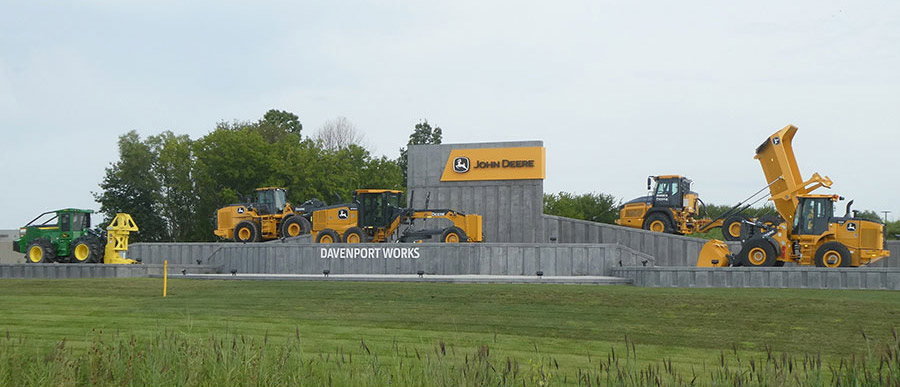
The 2025 Assembly Plant of the Year produces a variety of construction and forestry equipment, including (left to right) wheeled feller bunchers, production-class wheel loaders, motor graders, articulated dump trucks and utility-class wheel loaders. Photo by Austin Weber
Connected systems have enabled engineers to boost quality, improve throughput, maximize operational efficiency and streamline workflow. Without bulky wiring to deal with, assembly lines at the factory can be reconfigured in hours rather than weeks.
Fastening tools are equipped with wireless systems that monitor angle and torque, while automated guided vehicles enhance material handling. Computer vision and AI technology are used to inspect welds for quality control.
Whether it’s planting soybeans in Illinois, building roads in Brazil, harvesting wheat in Ireland, logging trees in British Columbia or shoveling iron ore in Australia, John Deere is known for building reliable off-highway machinery. Indeed, farmers and contractors around the world know that “Nothing runs like a Deere.”
Looking for quick answers on assembly and manufacturing topics? Try Ask ASM, our new smart AI search tool. Ask ASM
Looking for a reprint of this article?
From high-res PDFs to custom plaques, order your copy today!
That legendary reliability starts in factories such as the Davenport Works, which is the recipient of ASSEMBLY Magazine’s 2025 Assembly Plant of the Year award. The facility was selected for the 22nd annual award because of its innovative use of plant floor technology and Deere’s commitment to American manufacturing.
“There’s a genuine sense of purpose in what we do here, pride in the products that we produce and the customers who use them,” says Tom Johnson, factory manager. “There’s also a continuous improvement spirit and culture that we call ‘One Davenport.’”
That unique sense of camaraderie and teamwork was recently on display during a day-in-the-life event at the plant. Design engineers from Deere’s facility in Dubuque, IA, joined engineers and managers at the Davenport Works on the motor grader assembly line. Salaried employees partnered with hourly workers and rotated through workstations. That experience enabled them to get a first-hand look at various challenges and opportunities facing the high-mix, low-volume plant.
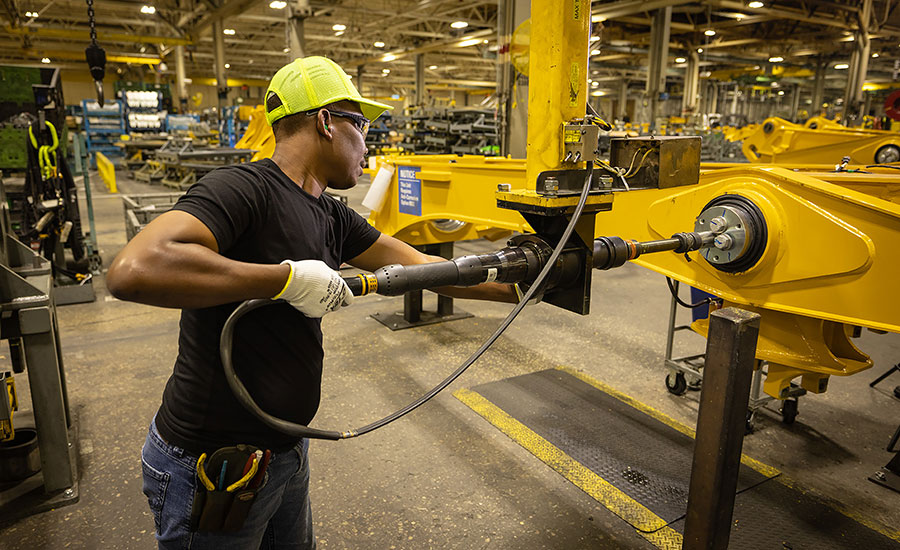
: The John Deere Davenport Works has invested in 5G connectivity, artificial intelligence, data analytics, digital twins and other advanced technology to streamline operations and improve productivity. Photo courtesy Deere & Co.
Powerful Machines
Deere’s first foray into non-agriculture equipment began modestly in the 1930s, when it produced industrial versions of the Model D tractor. The machines were painted yellow for extra visibility and were equipped with mounting pads on the frames for add-on equipment such as booms, loaders and sweepers.
However, things really took off in the late 1950s when Deere formed an industrial equipment division. Its first product was the 440 crawler dozer, which could accommodate either a front blade or a bucket. That small machine was eventually joined by a line of loader-backhoes, an elevating scraper and other types of rugged construction equipment.
To achieve economies of scale, many early machines shared components from the broader agricultural line. However, Deere turned heads in 1967 when it launched the JD570 motor grader. It was the world’s first all-hydraulic grader equipped with an articulated frame. The breakthrough enabled operators to maneuver the machine in tight areas that they were unable to work in previously.
Between 1976 and 1981, Deere’s construction equipment business increased dramatically as the company led the industry with an endless succession of innovative new machines. It also began developing larger equipment for mining and road building applications. The company also aggressively expanded into logging equipment, with machines adapted from the construction line.
Deere’s first factory devoted exclusively to construction equipment was the Dubuque Works, which today produces backhoes, bulldozers and skid-steer loaders. Deere also operates a factory in Kernersville, NC, that assembles hydraulic excavators and a facility in Thibodaux, LA, that makes scrapers. In addition, some construction equipment is made at plants in Brazil, China and Mexico.
Davenport Works opened in 1974 to produce Deere’s largest and most advanced equipment. The first products made at the original 400,000-square-foot facility were end loaders and excavators. Due to increasing demand in the early 1980s, the factory was eventually enlarged to more than 2-million square feet. Last year, the plant celebrated its 50th anniversary and built its 250,000th machine, a 544 P-Tier wheel loader.
Today, the Davenport Works is one of Deere’s largest facilities in the Quad Cities—a region that straddles the Illinois-Iowa border on the Mississippi River. The 188-year-old company is the biggest employer in the area, with numerous facilities, including four factories, an R&D center, proving grounds and the corporate headquarters.
Deere recently doubled down on its commitment to U.S. manufacturing, announcing that it plans to invest $20 billion during the next 10 years, including $250 million to modernize its facilities in the Quad Cities.
“Our commitment to delivering value for our customers includes ongoing investment in advanced products, solutions and manufacturing capabilities,” says John May, chairman and CEO of John Deere. “Over the next decade, we will continue to make significant investments in our core U.S. market. This underscores our dedication to innovation and growth while staying cost-competitive in a global market.”
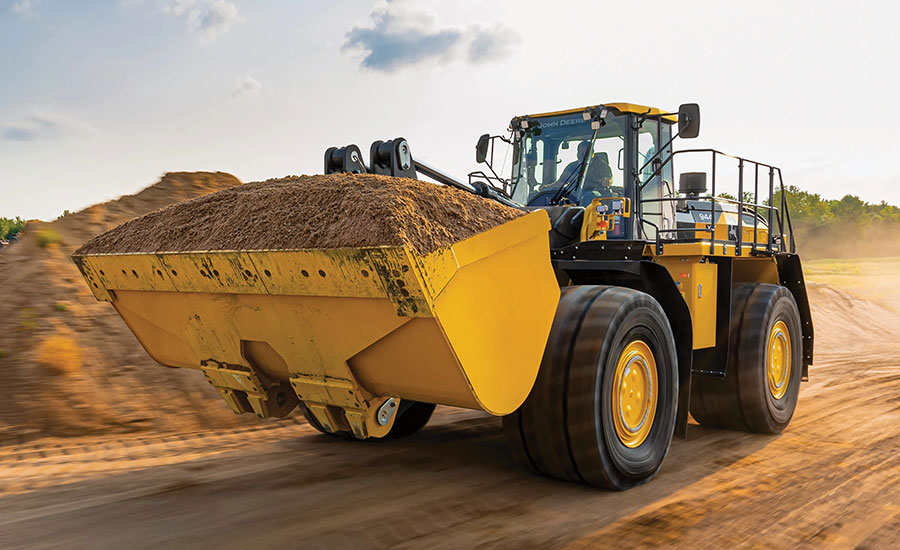
: The 944 P-Tier wheel loader is the heaviest machine that is made by Deere. Photo courtesy Deere & Co.
Multiple Models
Davenport Works serves as the “lighthouse” factory for Deere’s construction and forestry division, which includes nine plants worldwide. Assemblers build multiple types of heavy equipment on six flexible assembly lines at the vertically integrated facility. Yellow construction products include articulated dump trucks, motor graders, production-class wheel loaders and utility-class wheel loaders. Forestry products, which include skidders and wheeled feller bunchers, are painted in Deere’s distinctive shade of green.
Although the machines made at the 2025 Assembly Plant of the Year perform different functions, they all feature large rubber tires, rugged articulated frames and big diesel engines that produce high amounts of torque for exceptional power-to-weight ratios and fast cycle times.
Several assembly lines in the facility mass-produce wheel loaders, which are rubber-tired tractors equipped with large buckets that vary in size and payload capacity. The machines are typically used to transport coal, fertilizer, gravel, iron ore, salt, sand, soil, wood chips and other materials or aggregates short distances from stockpiles to conveyors, barges, dump trucks, railroad freight cars or wagons.
Wheel loaders can dig, carry and place large loads with unmatched mobility. Front-end buckets can be swapped out for hydraulic attachments such as forks or grapples that enable the versatile machines to pick up and handle many different types of objects, such as pallets, pipes or logs.
Davenport Works operates separate assembly lines dedicated to building large- and medium-sized wheel loaders. The former, which are referred to as production-class machines, are often used in mines or quarries. There are seven models in this product category, with engine sizes ranging from 303 to 536 hp.
The 944 X-Tier is the heaviest machine that is built by Deere. Its massive bucket alone weighs more than 16,000 pounds and can move up to 10 cubic yards of heavy material at a time. The tractor is more than 13 feet tall and weighs almost 125,000 pounds.
Mid-sized tractors are called utility-class wheel loaders. They are compact enough to easily maneuver around tight spaces, but have the power needed to handle a variety of attachments and tasks. The Davenport Works makes 10 types of medium loaders that range from 120 to 268 hp.
Wheel loaders are often paired with articulated dump trucks (ADTs), which are six-wheeled machines used to carry heavy payloads at construction sites, mines and quarries. They’re designed for use in demanding off-road environments and can operate safely on steep slopes and other uneven terrain.
Unlike a traditional rigid dump truck that rides on a single chassis frame, the cab of an ADT is mounted onto the front half of the chassis, while the dump body is mounted on the rear frame. An articulation joint located between the two halves contains a pivot point that enables them to move independently. Assemblers at the Davenport Works produce four sizes of ADTs ranging from 26 to 46 tons.
Earlier this year, Deere unveiled an autonomous ADT that is designed to address severe labor shortages. The 460E-II truck is equipped with advanced systems, such as satellite receivers, six stereo cameras and vision processing units. Artificial intelligence technology enables the 46-ton machine to make decisions and adapt to changes in its environment while navigating job sites independently.
Motor graders are known as the “Swiss army knife” of construction equipment. The six-wheeled machines feature a wide, adjustable blade that’s designed to create flat surfaces. They are also often equipped with ripper attachments that can be used to help prepare a jobsite for grading or leveling. Motor graders are used to maintain unpaved roads, establish the final grade on paved roads and remove heavy snow. Davenport Works produces motor graders in eight sizes, ranging from 215 to 300 hp.
The factory also assembles forestry and logging machines, including six different types of skidders. The four- or six-wheeled machines are used to carry and drag logs from wooded areas to a landing site where they are loaded onto trucks, railroad cars or barges for transportation to sawmills. They are equipped with either cables or grapples at the rear that attach to logs. A blade on the front end is used for decking logs and for rooting out stumps that could snag the skidder from underneath.
Two types of wheeled feller bunchers are made in Davenport. The machines are used in the logging industry to rapidly cut and gather several trees at once. Various sizes of felling head attachments cut standing trees, lay them down, saw the limbs off, trim the trunks to length and then stack them for a skidder to haul away.
At first glance, many of the machines on each of the six assembly lines at the Davenport Works share some similar characteristics. While takt times vary from product to product, all the items made in the factory use articulated frames, are mounted on large rubber tires and feature all-wheel drive transmissions. Each machine, except the ADT, is configured so the engine mounts behind the cab.
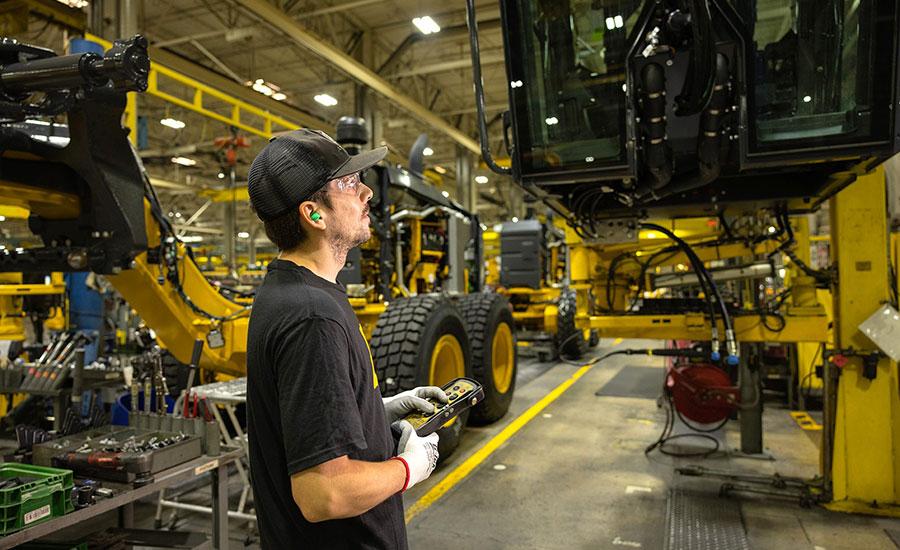
Connected systems have enabled John Deere engineers to boost quality and improve throughput at the Davenport Works. Photo courtesy Deere & Co.
High-Mix Production
Besides just paint color, many unique attributes distinguish Deere’s construction equipment from its iconic farm tractors and harvesters.
“Construction equipment is generally used for more hours per year than agricultural equipment,” says Johnson. “Like agricultural equipment, precision construction requirements are also increasing.
“As a result, we demand very tight tolerances throughout our fabrication processes,” explains Johnson. “Our products are very large and so are the advanced machining centers that produce them.”
Most of the manufacturing processes used to produce forestry equipment are similar to construction equipment. However, the machines are used in more rugged, remote environments, which is reflected in design aspects such as structural reinforcement. Trees are also sometimes harvested in steep slope environments, which require machines to be equipped with safety features such as extra-strong shackles and hitches or rotating and leveling cabs.
Whether it’s a construction or forestry machine, each product line at Davenport Works has its own design team.
“There is commonality in some subassemblies, such as engines,” says Johnson. “However, other components are unique to each type of machine, such as axles, cabs, frames and transmissions.
“We have many commodity parts for hardware like nuts, bolts and clips,” Johnson points out. “We are continuing to pursue more design opportunities for commonizing welding features to optimize our automated processes that we have and are enhancing, such as ‘weld trinkets’ like brackets, covers or hooks.”
Cabs are made at Deere’s Dubuque Works and engines come from the company’s Waterloo Works. Some components, such as controls, seats and transmissions, are purchased from outside suppliers and shipped to a nearby warehouse before they’re transported to the Davenport Works on a just-in-time basis.
However, axles and frames are a different story. Because they’re a critical component of every machine made at Davenport Works, they are fabricated and machined in-house using tight tolerances. The process starts when coils of raw steel are cut and then shot-blasted to increase its strength.
The facility recently shifted from plasma cutting to laser cutting, using higher kilowatt machines that can cut much thicker steel. Most of the steel used in production measures 2 to 2.5-inches thick, but Deere also cuts its own 10-inch-thick counterweights.
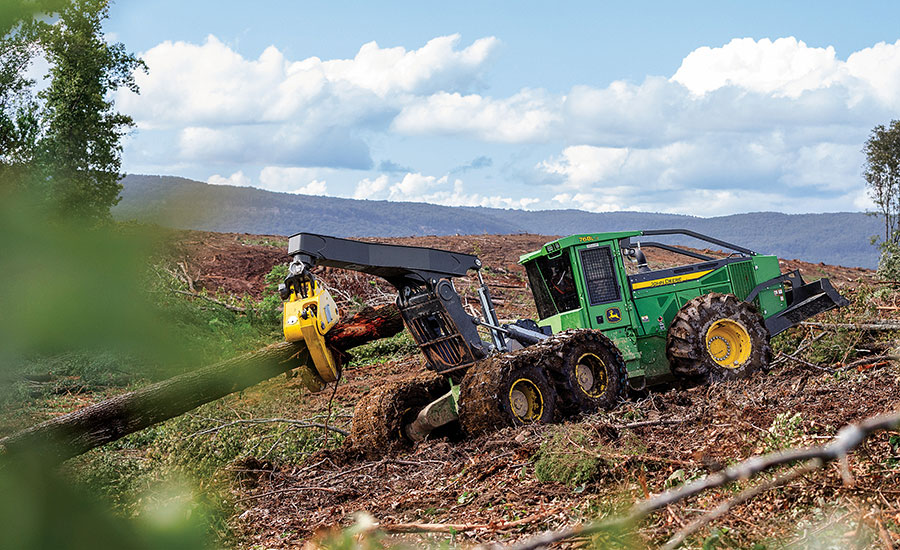
In addition to producing construction equipment, the Davenport Works makes machines for logging and forestry applications, such as six-wheel bogie skidders. Photo courtesy Deere & Co.
“To improve overall flow, we concentrate all fabrication activity on the west side of the factory,” says Johnson. “That results in a smooth flow between cutting, bending, welding and machining, moving from south to north.”
The Davenport Works also contains a state-of-the-art paint shop that uses both manual and robotic processes. Unlike other Deere factories, the 2025 Assembly Plant of the Year has a more complex painting operation. That’s because machines are painted both yellow and green.
While motor graders, wheel loaders and other construction equipment are painted in a yellow and black scheme, all forestry machines receive a coat of Deere’s distinctive green and yellow design.
The plant’s daily production cycle requires the use of 75,000 individual parts. That’s because all machines are built to order. Motor graders, for instance, are the most complex, with numerous types of features that customers specify.
Options include multiple types of tires and lighting configurations. In addition, customers can choose a variety of accessories, such as front, middle and rear rippers or scarifiers that are used to help loosen and remove rocks or debris.
To ensure that the right part or subassembly gets to the right line at the right time, engineers developed a homegrown manufacturing execution system (MES) called the John Deere Assembly Assist Tool (JDAAT).
“JDAAT links to our material requirements planning system and is able to drive orders based on customer demand,” says Dominic Susairaj, global manufacturing engineering and smart connected factory manager. “It links work instructions and discrete materials to the specific customer order to ensure the correct part at the correct time to the corresponding order.
“Our Smart Connected Factory strategy is built upon a solid data foundation that enables us to digitize, connect and optimize,” explains Susairaj. “To get parts from the warehouse to the assembly lines, we have developed three systems called MAAPOU (material availability at point of use), Material Coordinator Dashboard and Move a Part. Everything is tied together and tracked with a digital thread that tells where a part was requested from and where it was delivered to.
“Several years ago, we had a lot of paper-based systems in use at Davenport Works,” recalls Susairaj. “People spent a lot of time talking on radios, documenting on paper, and walking around the factory finding where the parts are. Today, we have digitized and connected everything together. Operators are able to push a button at their workstation and request parts.
“Currently, 95 percent of our assets are connected,” says Susairaj. “We have more than 195,000 active JDAAT parameters at Davenport Works that we collect from all of our factory floor assets.”
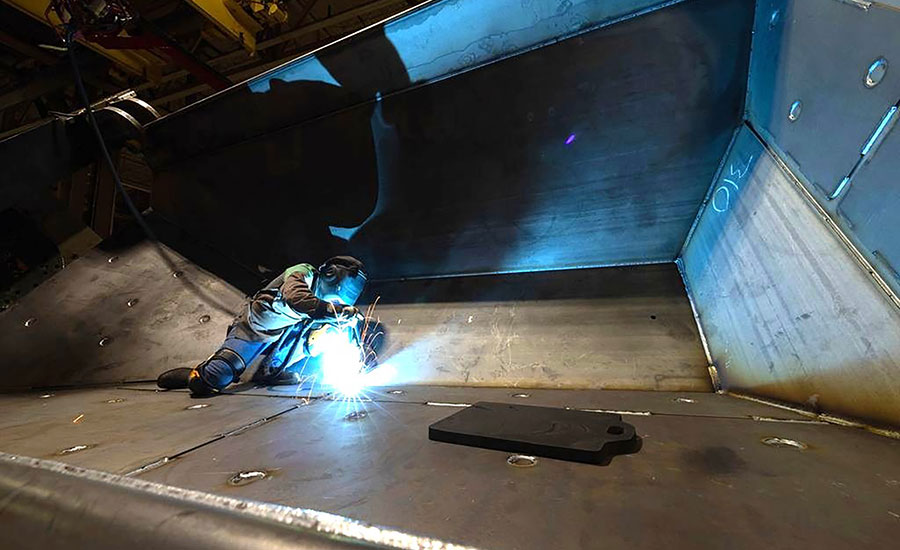
Welding plays an important role at the 2025 Assembly Plant of the Year. Photo courtesy Deere & Co.
Assembly Processes
Mechanical fastening and welding play critical roles at the 2025 Assembly Plant of the Year, which consumes thousands of fasteners and an average of 10,000 pounds of weld wire every day.
The fabrication department is home to a talented team of welders and support staff who have perfected the art of joining large metal components to produce heavy-duty frames that form the backbone of every piece of machinery made in the plant.
They also specialize in making big buckets. In fact, it takes 20 hours of manual welding and 14 hours of robotic welding to produce a 13-foot-wide bucket for the 944 wheel loader.
“We are deploying multiple new welding and material handling robots,” says Johnson. “Another recent initiative involves fixtureless welding to reduce the manual tacking process that occurs today in a clamp-fixture to facilitate robotic welding.
“The intent is to utilize design and automation to allow robots to align and weld parts together in the future without the need for manual tacking fixtures,” explains Johnson. “This will require repeatable, precision parts with locating features that are accessible with a robot.”
Deere engineers continually collect and analyze a variety of welding parameters to improve operations.
“One type of data being collected with automated welding is quality driven mistake proofing and no-fault-forward assurance,” Johnson points out. “This reduces the impact of finding mistakes at the assembly process, where rework becomes more difficult and expensive, due to all the operators and workstations being affected until the issue is resolved.”
Davenport Works is also using AI and machine vision technology to automatically spot and correct welding defects in real time.
“With proper part location and lighting, computer vision and machine learning systems can be trained to identify visual defects in welds or missing weld content,” says Johnson. “The system can then be connected to the MES to ensure that verification occurs before the weldment can proceed to the next operation.”
Axles, frames, engines and other heavy parts move within the factory using carts and tuggers, in addition to lift tables, overhead cranes and jib hoists. Assemblers use cordless, DC electric and pneumatic fastening tools to build machines.
“We have a variety of types to ensure we have the proper tool for the job,” says Johnson. “We analyze each joint based on criticality and potential risk, then apply the appropriate tool for the application.

Without bulky wiring to deal with, assembly lines at the Davenport Works can be reconfigured in hours rather than weeks. Photo courtesy Deere & Co.
“We have general commonality with our tooling and strive to maintain consistency,” notes Johnson. “Our focus is on operator safety and product quality, so we are constantly looking for better options. If there is a new tool that will provide the required output, we won’t shy away from breaking commonality.
“In general, we follow the same methodology across product lines for torque applications,” says Johnson. “That consists of a detailed analysis of each joint, ensuring we have the appropriate tooling and controls in place.
“There is variation across joints which would impact which tool is used and what controls are in place,” explains Johnson. “5G implementation provides a more robust foundation for all our tools and control connections across the factory.”
According to Johnson, each smart tool has its own level of control and capability. It verifies that the correct amount of torque has been achieved and communicates back to the MES before a machine can proceed to the next workstation.
“The data available is based on the tool used in that application,” says Johnson. “For a tool where achieved torque values are available, that data can be compiled and analyzed for process capability. That data is used by our engineers to ensure that we are maintaining product quality. It enables them to make adjustments, as necessary.
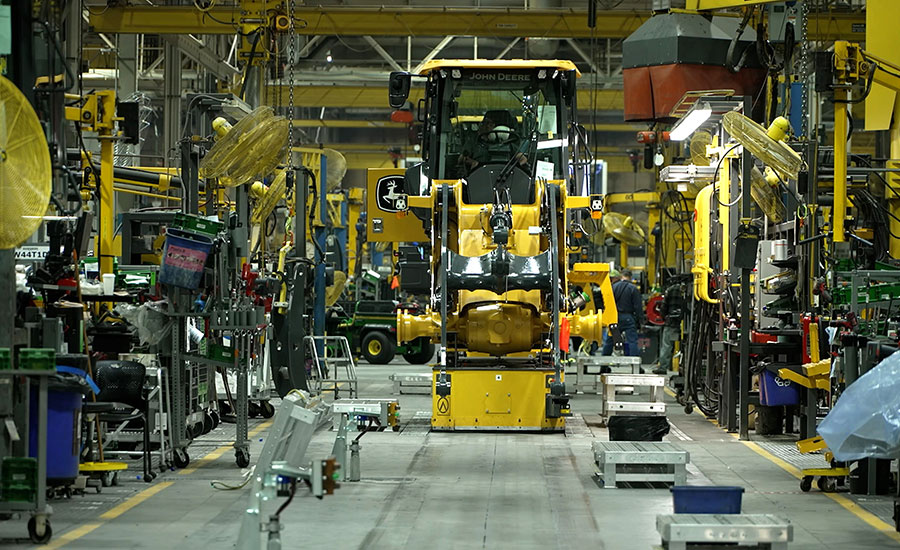
Battery-powered flatbed transporters help boost throughput on the plant’s highest volume assembly line. Photo courtesy Deere & Co.
Error-Proofing Initiative
Davenport Works is also using technology to error-proof its assembly lines.
“Smart tools are used to give operators feedback that the correct torque has been achieved and the torque values are captured and retained,” Johnson points out. “The MES system will not allow tooling to turn on if the sequence of events is violated. Cameras are also deployed to inspect and verify that assemblies have been built properly.
“We are integrating vision systems and smart tooling into our MES system to give real-time feedback to assemblers to eliminate variation in the assembly process and correct any mistakes at the source,” adds Johnson. “This technology has also helped us control our inventory levels to ensure we have the right part at the right place at the right time.
“Our MES provides the opportunity to share issues directly with operators before a machine leaves their station,” says Johnson. “Any issue will pop up on their computers, which provides visibility to open items on that specific machine that need to be addressed. It can also provide visibility to issues found on previous machines to prevent recurrence of those items.
“Vision systems create the ability to alert the need for replenishment in a more efficient and timely manner,” explains Johnson. “Additionally, these systems create data time stamps so the material flow processes can properly replenish the right parts at the time interval.”
While each machine made at the Davenport Works is unique, the six assembly lines share some common elements. For instance, ADTs, motors graders and other products move down linear lines that flow from east to west. The flexible lines can accommodate a wide product mix while supporting process improvements.
Assemblers typically start working on the rear half of machines, where diesel engines, exhausts, cooling systems and hoses are installed. In the middle of the assembly lines, large parts, such as cabs and the front halves of articulated frames, move north or south from subassembly lines. At “marriage” workstations, the two frames are joined together.
“Consistent material flow practices allow for easier transition of people and processes to combat the complexity within our assembly areas,” says Johnson. “Without properly designed and executed material flow processes, operators would not be able to create value by transforming the component parts into larger, more valuable assemblies.”
Most machines are pulled from workstation to workstation using tuggers. However, engineers recently installed an automated conveyance system to assemble utility-class wheel loader lines. The battery-powered flatbed transporters help boost throughput on the plant’s highest volume line.
“This autonomous vision-guided vehicle system helps remove the need for manual tracking using pieces of paper and moves us to a fully digitalized process,” says Johnson. “Additionally, we have increased the efficiency of the delivery process to assemblers by creating assembly stands vs. the previous delivery method of conveyors, which limited operator flexibility.
“Our engineering teams are consistently working on in-house developed system to improve production methods,” explains Johnson. “For example, on the utility-class line they created a semiautomated wash booth. It delivered effective results needed for our operation at a fraction of the cost of off-the-shelf or fully integrated systems offered by suppliers.”
Another home-grown system is called SmartTest.
“SmartTest is a testing framework designed to enhance the efficiency, quality, accuracy and scalability of our product validation process,” says Johnson. “It leverages automation, data analytics and real-time feedback to ensure that issues are detected and resolved faster.
“SmartTest supports better traceability and collaboration across teams, which was limited in our older systems,” adds Johnson. “It provides actionable metrics to improve both product and process quality.”
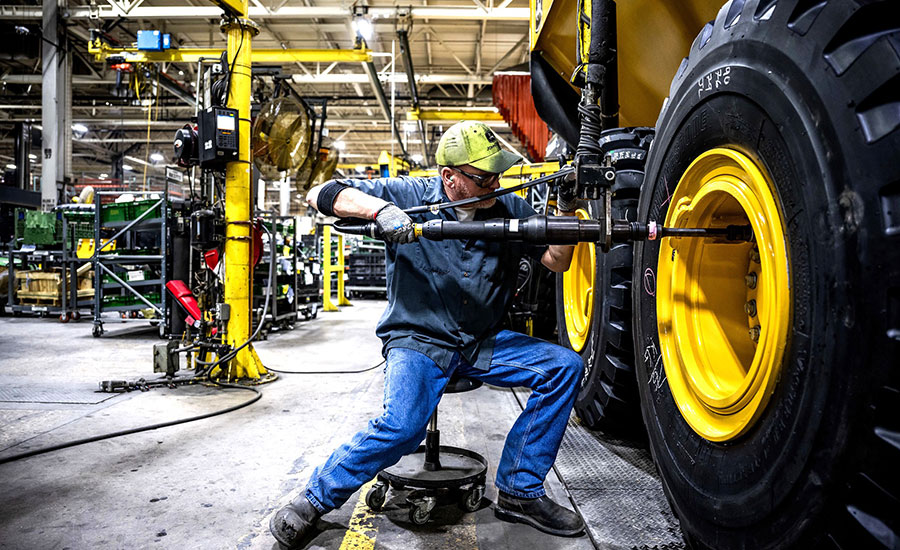
Fastening tools used at Davenport Works are equipped with wireless systems that monitor torque. Photo courtesy Deere & Co.
Enhancing Factory Operations
Several years ago, Deere began implementing a “smart industrial strategy” at several factories, including Davenport Works. “Smart” refers to capturing vast amounts of data, analyzing it and providing insights that can improve overall operations.
“We build big things here,” says Johnson. “Because of the physical size and complexity of our products, we can’t automate much of the assembly. So, we must find other ways to drive productivity improvements. That’s where a smart connected factory plays a key role.
“Deere has always been known as a manufacturing company that is technologically advanced,” adds Jason Daly, vice president of earthmoving sales, marketing and customer success. “Being a smart industrial company has given us the liberty to take some calculated risks, and to drive change in the way we think and operate. Every day, we consider how making an investment in new technology will impact our customers for the better.”
According to Daly, the goal of the smart industrial initiative is to integrate cutting-edge technology both on Deere machines and within its factory walls.
“We have historically been a manufacturing company, and we still need to be a manufacturing company that produces the world’s best equipment,” says Hindman. “That’s every bit as important today as it was yesterday. Technology now provides us an opportunity to differentiate the product even further than it already is.”
That’s why Deere decided to plunge into 5G technology, which is one of the pillars of Industry 4.0. It dramatically transforms the way that conveyors, fastening tools, robots and other production equipment interacts on the plant floor.
“[Our] manufacturing facilities are extraordinarily complex environments that rely on automation and connectivity,” explains Hindman. “With miles of embedded Ethernet cables connecting Wi-Fi drop points in factory ceilings, the facilities are faced with limited flexibility for set up and upgrades.
“5G enables private LTE networks and will allow [our engineers] to design a more flexible, nimble and connected facility, creating opportunity for further advancement and greater efficiency that will transform the manufacturing process.
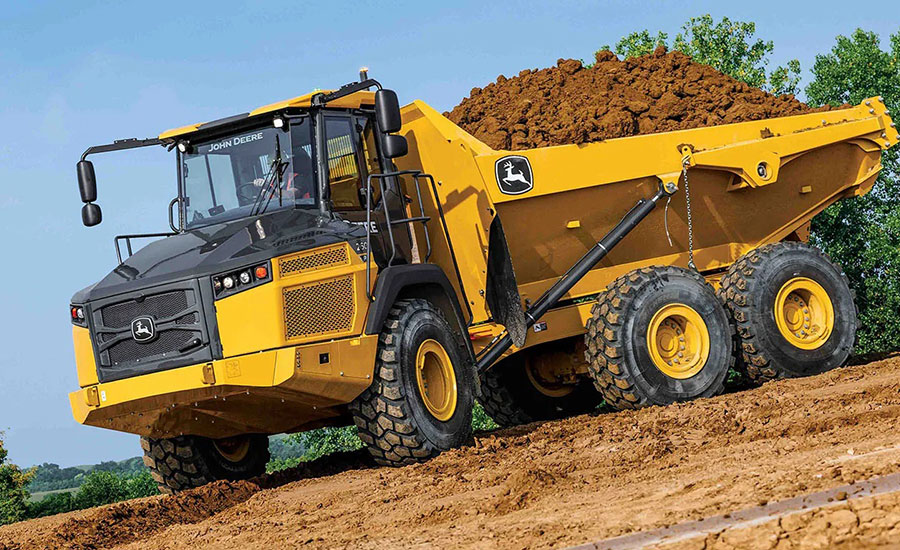
Assemblers at the Davenport Works produce four sizes of articulated dump trucks. Photo courtesy Deere & Co.
“Private 5G LTE also creates the opportunity to expand factory capabilities leveraging edge computing, analytics and autonomous devices, and empowers a larger set of smart applications like real-time location systems, asset tracking, inventory management, wearables, building automation, and robotics for operational cost savings.”
According to Hindman, the technology provides the ability to connect multiple devices at once and move more data faster than ever. It enables engineers to deploy artificial intelligence, data analytics, digital twins and other smart factory tools.
Private 5G enables millions of devices, such as actuators, cameras, motors and sensors, to be connected wirelessly with each other. That improves the automation of production processes and real-time monitoring of machine conditions.
The technology features simplified device configurations, compact infrastructure and reduced bandwidth usage. This results in lower power consumption, cost efficiency and improved performance over traditional Wi-Fi in speed, data processing, connection stability and low latency. A private network enables high-speed wireless communication for tools and equipment, and enables Deere to bypass traditional telecom providers and address cybersecurity concerns
“Private 5G networks help us automate operations, boost efficiency and deliver the best possible product to our customers.”
– Jason Wallin, principal architect of infrastructure and operations, Deere
For example, replacing Ethernet cables with wireless connectivity reduces the need for copper wire. John Deere’s private 5G network can also support up to 800 devices per radio, compared to just 50 on a typical Wi-Fi access point.
“Connectivity is the heart of smart factories,” says Jason Wallin, principal architect of infrastructure and operations at Deere. “Private 5G networks help us automate operations, boost efficiency and deliver the best possible product to our customers. But, the benefits go beyond the factory floor. The technology enables us to adapt to shifting market conditions and optimize workflows.
“Adding 5G connectivity allows us to add many more torque sensors to the factory floor than what would have been possible with Wi-Fi and traditional Ethernet connection,” claims Wallin. “Additionally, the new 5G connections can be enabled in minutes vs. the days or weeks that it would have taken in the past.
“The layout of Davenport Works is always adapting to new products and processes, as well as being optimized with continuous improvement initiatives,” explains Wallin. “There is an ongoing evolution.
“As with any changes to the layout, relocating utilities and process equipment can be expected. 5G has helped to address this by minimizing the amount of utilities that need to be relocated and simplifying the coordination for connectivity previously required, for example, on network hubs.”
Other technology tools, such as AI and immersive digital twins, are also enabled by 5G. For instance, Davenport Works has created an operations digital twin and a product digital twin. “The operations digital twin is the digital representation of a unique system or process in real time or on a timeline,” says Johnson. “We have enabled the technology through leveraging facility scanning, 3D layouts, machine connectivity (assets, tools, devices) and overlaying data streams on digital artifacts. Examples include location telemetry of parts and material handling equipment.
“The product digital twin is the digital representation of a unique product. We have enabled the technology by leveraging engineering data to visualize a serialized configuration of a product as designed, as manufactured and as sold to the customer. We are currently leveraging a 3D model of the vehicles we build to collect critical manufacturing data that will be included as part of the digital thread or ‘machine biography.’”
Engineers and operators at the Davenport Works can also tap into a digital device called “Johnny.” The AI tool helps them to be more productive.
“The technology we’re implementing is designed to enable our employees to be more efficient at their jobs, as opposed to being used to eliminate jobs,” says Johnson. “As we embrace AI and other new technology, we’ve been running sessions to educate people about it so they understand our goals.”
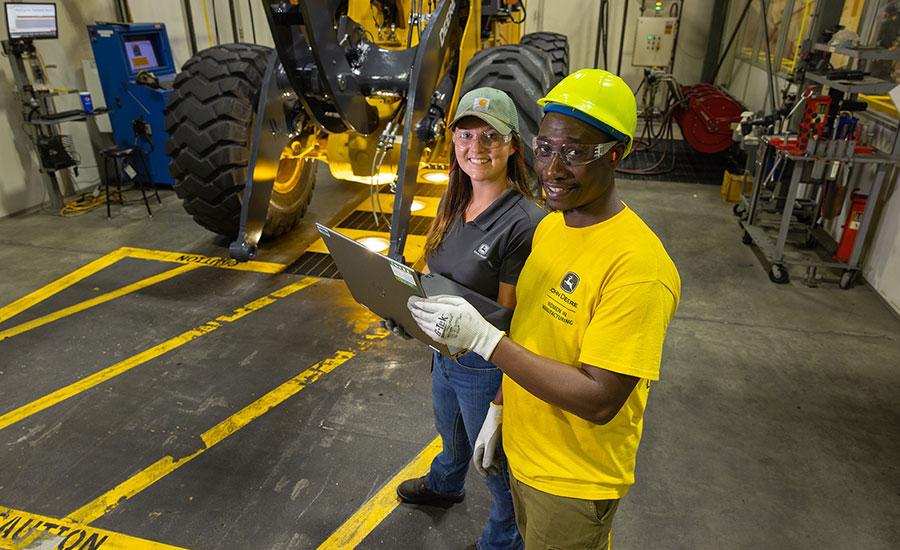
SmartTest leverages automation, data analytics and real-time feedback to ensure that production issues are detected and resolved fast. Photo courtesy Deere & Co.
The Softer Side of Manufacturing
Advanced technology tools are great, but at the end of the day, manufacturing still relies on people. That’s why the 2025 Assembly Plant of the Year excels at a variety of softer initiatives designed to improve current and future operations.
Davenport Works holds an annual CI Fair that taps into the core principles of the Deere Production System—continuous improvement, standardization and waste elimination. It’s a friendly competition that resembles a school science fair; different departments and teams within the factory have an opportunity to share ideas for continuous improvement.
All employees have a chance to look at the various projects and interact with all the engineers and operators behind them. Assembly lines are shut down for the day. Each project is summarized on a display board, and employees have an opportunity to explain their ideas. Projects that receive enough votes receive an award that’s made in-house by welding apprentices.
Another unique initiative is called Factory to Field. “It is designed to get representatives from within our factory walls to increase engagement with our dealer and customers,” explains Johnson. “This includes ongoing discussions with our field team and physical visits to dealers and customers.
“These representatives will then compile their learnings and share back with the rest of the factory,” says Johnson. “We try to leverage all forms of feedback to improve our products and our processes. There is no better way of getting that feedback than getting direct interaction between our factory employees and our customers at their jobsites.”
Johnson is also proud of the plant’s high school registered apprenticeship programs in welding, engineering and supply management that is designed to develop the next generation of talent.
The homegrown welding apprentice program began five years ago and currently has 10 students enrolled. It starts the second semester of junior year, and Deere provides both transportation and lunch. A weld apprentice lab located on the plant floor features 18 welding booths for manual applications, including a welding robot.
The Davenport Works also has an outreach program aimed at local elementary schools. The initiative is led by a welding engineer through the John Deere Inspire program. Deere has had more than 12,000 students participate in 105 unique outreach events so far this fiscal year.
At one event, a pop-up “factory” taught fifth graders how that day’s math lesson connects to future careers in manufacturing. The hands-on experience featured mini workstations and assembly lines that explained how each person plays a small role to complete a bigger task. Students also built paper dump trucks and used welding simulators to apply various STEM lessons.
Previous recipients of the Assembly Plant of the Year award were GE Appliances (Louisville, KY); Taylor Guitars (El Cajon, CA); Brose Tuscaloosa Inc. (Vance, AL); GKN Automotive (Newton, NC); Murakami Manufacturing USA Inc. (Campbellsville, KY); GE Appliances (Decatur, AL); Ford Motor Co. (Sterling Heights, MI); AGCO Corp., (Jackson, MN); Bosch Rexroth Corp. (Fountain Inn, SC); Polaris Industries Inc. (Spirit Lake, IA); STIHL Inc. (Virginia Beach, VA); Northrop Grumman Corp. (Palmdale, CA); Ford Motor Co. (Wayne, MI); Philips Respironics (New Kensington, PA); Eaton Corp. (Lincoln, IL); Batesville Casket Co. (Manchester, TN); IBM Corp. (Poughkeepsie, NY); Schneider Electric/Square D (Lexington, KY); Lear Corp. (Montgomery, AL); Xerox Corp. (Webster, NY); and Kenworth Truck Co. (Renton, WA).
A nomination form for the 2026 Assembly Plant of the Year award will be available on ASSEMBLY's website in early January.Testing the Metal
During a recent visit to the Davenport Works, I had a chance to get an up-close look at how Deere is using 5G networks, data analytics, smart torque tools and other technology for mistake proofing and quality control.
On one assembly line, I tested a DC electric tightening system (see photo below) that’s used to produce the company’s articulated dump truck (ADT). It’s connected to the John Deere Assembly Assist Tool, a homegrown manufacturing execution system that connects operators and workstations.
Under the watchful eye of an engineer, I maneuvered an ergonomic manipulator arm toward several bolts attached to a large ZF transmission housing on a subassembly line. It’s located near the marriage station that attaches the front and rear frames of the large vehicle. The ADT is the only machine produced at Davenport Works where the engine and transmission are located on the forward chassis.
It took me several tries before I achieved the correct run down with the stationary, semiautomatic smart tool and received a thumbs up from the engineer. The built-in poka-yoke system rejected my initial efforts, because the amount of torque I exerted was incorrect.
By ensuring that fasteners are installed correctly, the 5G- and AI-connected system improves process optimization and validation. It is designed to mistake-proof the bolt fastening process and reduce the chances of operator error. Along the way, it captures critical data for analysis, such as torque angle.
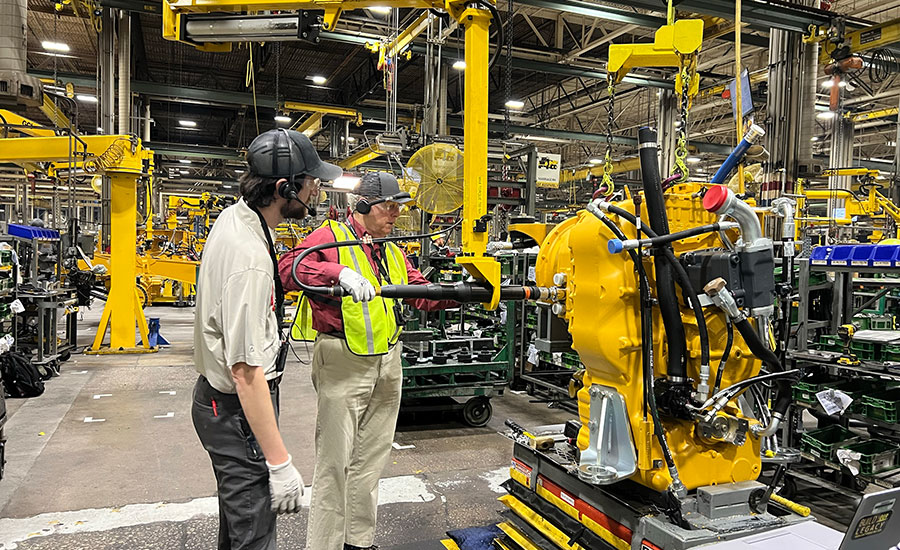
State-of-the-art fastening tools capture critical production data and improve quality at the 2025 Assembly Plant of the Year. Photo courtesy Deere & Co.
While I was in the Quad Cities, I also had a chance to test drive several machines at Deere’s state-of-the-art proving ground in Coal Valley, IL. “Just hop in” said a friendly engineer as I climbed up into the spacious cab of a 872G/GP motor grader (see photo below), after donning the appropriate safety gear. The 300-hp machine is the largest of eight different models made at the 2025 Assembly Plant of the Year.
At first, I was a bit intimidated by all the various buttons and controls, but relieved to see a familiar steering wheel. As I settled into a comfortable seat, I pushed a button to start up the six-wheel-drive machine.
After disengaging the parking brake, I found the forward gear and slowly began rolling inside the confines of Deere’s large “sand box.” I was impressed by the high visibility of the cab and by how quiet it was, especially since a large diesel engine was sitting just a few feet behind me.
In particular, the steering wheel felt normal and was extremely responsive. One slight touch and 47,000 pounds of yellow iron easily moved right or left. As I maneuvered over some bumpy terrain, the controls were within easy reach and quick to respond.
I also tried my hand at adjusting the machine’s 12-foot-wide blade. With the push of a button, I was able to lower the moldboard into position. As I drove through small mounds of dirt, I glanced out the large front window and was impressed by the machine’s ability to quickly smooth out everything in its path.
After I carefully climbed out of the cab, an engineer walked me around the machine, highlighting key design features, such as an articulated frame that can handle all kinds of demanding terrain. He showed me some of the critical weldments and bolted joints that ensure the motor grader’s durability, reliability and smooth operation in the field.
In addition, the engineer pointed out the location of a few of the sensors that control a unique feature called SmartGrade. The in-cylinder devices enable the big machine to stay on grade no matter what type of blade angle or pitch is being used.
Overall, I was awed by the power of the machine and impressed with its maneuverability. The experience brought back childhood memories of playing with Tonka toys in my backyard sand box. Except, the Real McCoy I drove cost more than $500,000.
I gained a new appreciation for a machine that I had seen the day before in various stages of production on one of the assembly lines at the Davenport Works. And, I wondered what John Deere himself would think if he saw this yellow beast in action plowing through dirt.
—Austin Weber
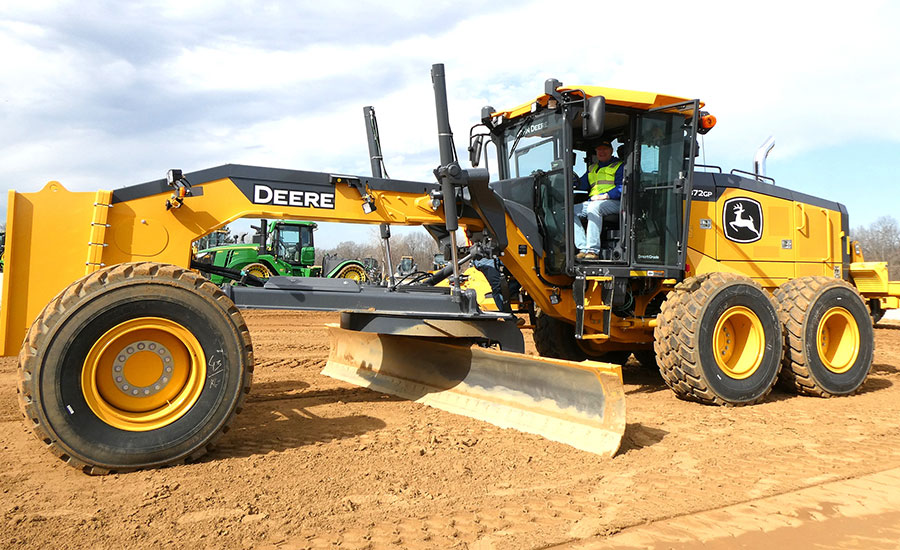
The John Deere Davenport Works produces eight different motor grader models. Photo courtesy Deere & Co.
It Started With a Plow
Deere & Co. is a $52 billion multinational corporation with manufacturing operations in 15 countries on five continents. It is the largest agricultural machinery manufacturer in the world and the third largest producer of construction equipment. But, the company traces its innovative spirit back almost 200 years to a small country blacksmith shop.
John Deere was a 32-year-old blacksmith from Middlebury, VT, who heeded advice to “go west” when he moved to a town on the Illinois prairie in 1836. Grand Detour was located on the edge of the American frontier, 100 miles west of Chicago.
Deere set up a small shop near the banks of the Rock River and began making axes, hinges, horseshoes, knives, nails, pitchforks, wagon wheels and other items. At the time, local farmers were using primitive hand tools and crude cast-iron plows attached to horses or oxen. However, they were having a difficult time plowing their fields, due to sticky soil conditions that made a laborious process even harder.
In 1837, Deere came up with an ingenious answer to the problem. He forged a rugged implement equipped with a steel blade that could slide more easily through the soil and make farmers more productive.
Deere cut the teeth off of a broken steel saw blade by hand, then heated one small section at a time, molded it with a hammer and attached the blade to an iron moldboard.
“Next, he dug up a sapling and shaved two plow handles, which he connected to a carved beam,” says Neil Dahlstrom, chief archivist at Deere and co-author of The John Deere Story. “An upright standard, molded from the bar iron stock used to make ironware, connected the beam and moldboard.”
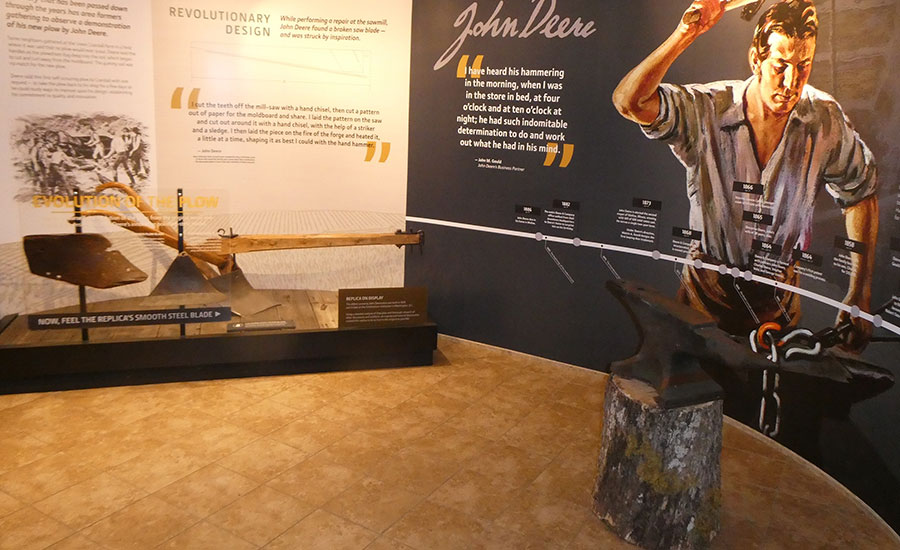
John Deere created a new type of plow in the mid-1830s. Photo by Austin Weber
Deere encouraged his first customers to return products so that he could inspect them for wear and improve upon his design. However, his new plow was not an instant hit; he only made 10 implements during the next two years.
In 1840, for the first time, the census listed Deere’s occupation as an agricultural manufacturer. That year, he built 40 plows. The next year, he made 75 implements and then 100 in 1842.
As business picked up, Deere constructed an 800-square-foot addition to his shop. Outside, a horse-driven treadmill turned a grinding wheel that was used for polishing steel. The wooden treadmill, 25 feet in diameter, had teeth underneath it that engaged a lantern gear that turned an overhead line shaft and belt inside the small building.
Soon, Deere began to advertise in local newspapers, proclaiming that his plows were “ground smooth, so that it scours perfectly bright in any soil, and will not choke in the foulest of ground.”
By 1846, Deere was producing 1,000 plows a year. “But, as production increased, so too did the need for a steady supply of quality steel, iron and lumber,” says Dahlstrom.
To address the issue, Deere decided to move his modest operation 70 miles southwest to Moline, IL, in 1848. The growing town was located on the banks of the Mississippi River and within a few years was also served by the newly constructed Chicago & Rock Island Railroad. Barge and rail transportation provided an easy way to bring in raw materials and ship out finished goods.
By late 1851, Deere’s water-powered factory was making 70 plows a week. Within six years, it was producing more than 13,000 units annually.
John Deere and his son, Charles, quickly expanded the company through clever marketing campaigns, eventually making it the largest plow manufacturer in the world. They also branched out beyond plows and began producing other types of horse-drawn farm implements, such as corn planters, cultivators, cutters, grain drills, harrows, manure spreaders and wagons.
Deere & Co. received its first U.S. patent (for an “improvement in cast steel moulds”) in 1864. “Whereas the standards process left air spaces in the castings of ‘moldboards, landsides and other articles in steel,’ Deere’s patented method produced perfect steel castings more easily and at no greater cost than the traditional method for casting iron in sand molds,” explains Dahlstrom.
In the mid-1870s, Deere & Co. was issued its first U.S. trademark—a deer jumping over a log. By then, its 90,000-square-foot Plow Works was proclaimed to be the “largest steel plow factory in the world.” Floor space grew from 9 acres in 1882 to 35 acres by 1904. A few years later, the company’s world-famous green and yellow paint scheme became standard on all of its products.
Deere began making harvesting machinery in East Moline, IL, in 1912 and six years later purchased the Waterloo Gasoline Tractor Co. Along the way, the company built a large foundry and a state-of-the-art engine factory in Waterloo, IA. Those facilities still supply most of the metal castings, components and subassemblies used today by the Davenport Works and other facilities.
When John Deere passed away in 1886, he was hailed as a humble, self-made entrepreneur who achieved success through “hard work and integrity of purpose.”
“To preserve his plow’s reputation as the best in America, John Deere worked continually to improve manufacturing processes and implement designs,” says Dahlstrom. “Deere never claimed to have invented the steel plow or even to have been the first to advance it. His contribution to the company and to its customers, as he understood it, was constant improvement, quality craftsmanship and superior sales efforts.”
Deere’s legacy shares several similarities to another legendary American manufacturer: Ford Motor Co. Like Henry Ford, John Deere did not invent the product he’s famous for. Instead, he took an already existing product, made it better, and found a cost-effective way to mass-produce and market it.
A key ingredient behind the success of both their companies was vertical integration. And, both firms were run by several generations of descendants. In fact, when the last member of the Deere family to lead the company, William Hewitt, retired as CEO in 1982, it marked 145 continuous years of succession.
Today, one of John Deere’s first plows is on display at the Smithsonian Museum of American History in Washington. His namesake company also prominently displays an early implement in the lobby of its global headquarters in Moline.
Deere is proud of its unique heritage and maintains a large archives nearby that contains a treasure trove of materials ranging from old advertising signs and sales brochures to a climate-controlled garage full of historic tractors and machinery. The company also operates a working replica of John Deere’s original blacksmith shop that is open to the public in Grand Detour, IL.
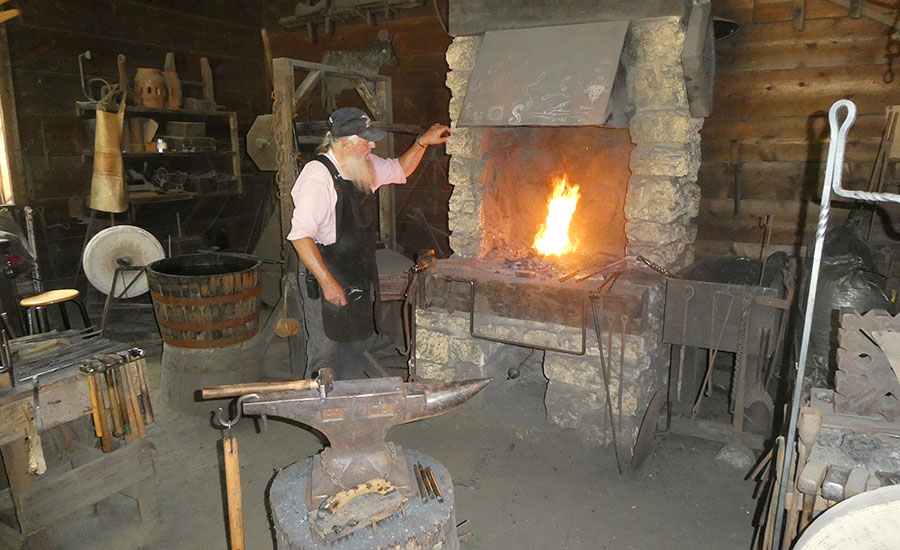
Deere & Co. traces its innovative spirit back almost 200 years to a small country blacksmith shop. Photo by Austin Weber