Robotics
Robotics Developers Target High-Variability Assembly as Automation Expands
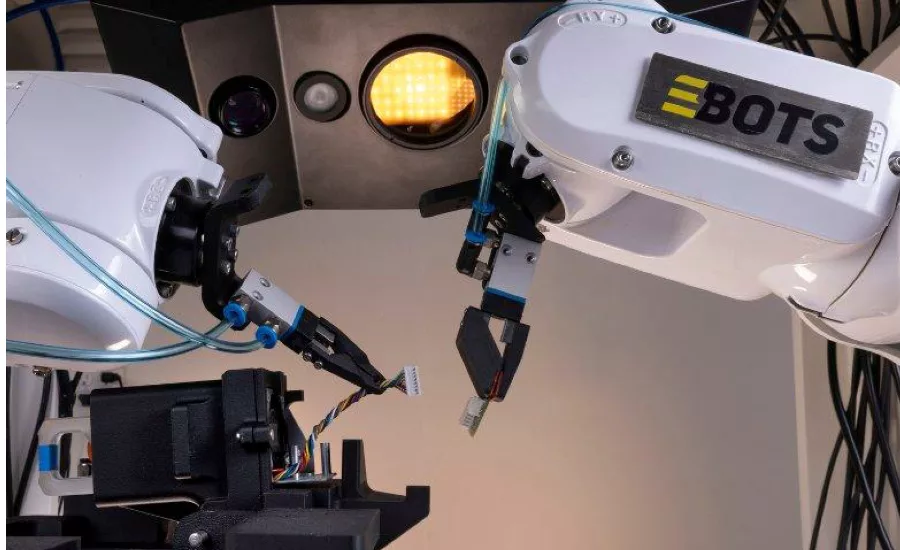
FREMONT, Calif. — Manufacturers have long automated repetitive, high-volume production tasks, but many assembly operations that require dexterity and adaptability have remained difficult to automate.
A new generation of robotic systems is beginning to address those gaps. Companies are developing technologies designed to handle high-mix, high-variability assembly tasks, including cable routing, flexible circuit insertion and micron-level component placement.
eBots Robotics, a Silicon Valley-based company, is among those focusing on these applications. The company has developed dual-arm robotic systems designed to perform assembly work that traditionally required skilled human operators, particularly in industries such as electronics, semiconductors, medical devices and electric vehicles.
The systems use synchronized dual-arm coordination combined with machine vision to guide assembly processes. According to the company, its platform achieves positioning accuracy down to 22 microns and operates at high processing speeds to support real-time adjustments during assembly.
Unlike conventional automation systems optimized for stable, repeatable processes, the new approach targets tasks where parts vary, orientation changes or materials are flexible. These include wire harness assembly, flexible printed circuit insertion and multi-step component handling that require continuous adjustment during operation.
Manufacturers have struggled to automate these processes because they require a combination of perception, precision and decision-making that has historically been difficult to replicate with traditional robotics.
“Automation solved low-mix, high-volume manufacturing a long time ago,” the company said in a press release. “The final frontier is high-mix, low-volume, where the task changes and the robot needs to keep up.”
Looking for quick answers on assembly and manufacturing topics? Try Ask ASM, our new smart AI search tool. Ask ASM
The push to automate more complex assembly tasks comes as manufacturers face ongoing labor constraints and increasing demand for precision production. As product designs become more compact and complex, assembly processes often require tighter tolerances and more flexible handling.
eBots said its systems are designed to operate in these environments without requiring extensive reprogramming or engineering support when tasks change, a common limitation in traditional automation deployments.
The company reports assembly yields exceeding 99.95% in production environments, a level of consistency that has drawn interest from manufacturers seeking to improve quality while reducing manual intervention.
As manufacturers continue to adopt automation across production lines, systems capable of handling variable assembly tasks could expand the range of operations that can be automated, particularly in sectors where precision and product variation are increasing.
Looking for a reprint of this article?
From high-res PDFs to custom plaques, order your copy today!



.webp?height=200&t=1773881394&width=200 "Rhoda AI introduced FutureVision")