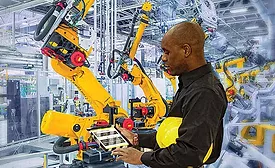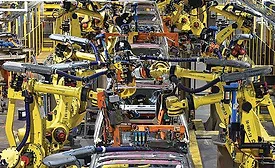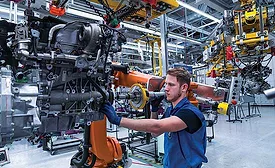
Factories of the future will feature advanced technology, such as additive manufacturing, artificial intelligence, augmented reality, data analytics and digital twins. While many manufacturers are still ramping up their Industry 4.0 initiatives, several assembly plants are already at the forefront. They are embracing the Fourth Industrial Revolution and reaping the benefits.
More than 20,000 manufacturing professionals saw the newest robots, vision systems and motion control technologies during the 2019 Automate show and conference, which was held April 8-11 at McCormick Place in Chicago.
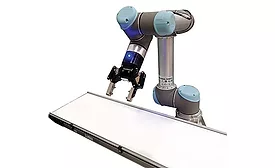
Denmark is famous for being the home of Hamlet, The Little Mermaid and Lego. The nation is also well-known for its thriving robotics industry, thanks in no small part to Universal Robots A/S.
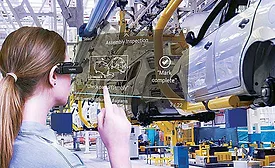
Traditionally, it's not unusual to see people wear goggles and other types of safety glasses in factories. But, a new class of wearable devices is becoming increasingly popular on assembly lines.
In just a few short years, deep learning software has improved to the point that it can classify images better than any traditional algorithm—and may soon be able to always outperform human inspectors
For many years, pet food manufacturers have used machine vision software to verify the presence of unique characters, codes, colors and graphic shapes on packaging for dog and cat food. Today, however, these companies can complement this process by also verifying the presence of a dog or cat image on the packaging using deep learning vision software.
Robots and other automation technologies have greatly increased productivity in today's factories. However, they still have one major limitation: They require people to tell them what to do.
Just as lean manufacturing is about more than eliminating waste, Industry 4.0 is not merely a matter of connecting machines and products via the Internet.
By now, we've all heard the hype: The Industrial Internet of Things (IIoT) will fundamentally change manufacturing and offer a cornucopia of benefits, including increased efficiency, higher quality and more responsive supply chains.
Data analytics, augmented reality, generative design, artificial intelligence, cobots, additive manufacturing and other technologies are already helping manufacturers increase efficiency, reduce downtime, lower prices, differentiate themselves in the marketplace, and improve service, delivery and quality.