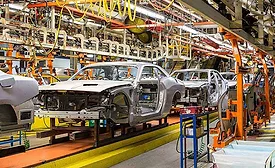



A slightly crooked painting gets most people’s attention, whereas very few people will notice a car door that is askew by less than a millimeter. Catching that imperfection is often reserved for trained personnel on an automobile assembly line.
Based in Genoa, Italy, Istituto Italiano di Tecnologia (IIT) is one of the best research centers throughout all of Europe. Researchers there focus on several specialties, including robotics, computer vision and optical microscopy.
Traditionally, electric traction motors use permanent magnets made with rare-earth metals. However, materials such as dysprosium and neodymium are a limited resource.
According to the Bureau of Labor Statistics, U.S. manufacturers had 858,000 unfilled jobs in November 2021. Why is that, and what can manufacturers do about it?
Simulation and analysis software improves 3D-printed structures for Urwahn Bikes.
July 18, 2022
Additive manufacturing has become a well-established process in bicycle manufacturing. While the average road bike might not have any 3D-printed components, high-end bike makers are appealing to competitive cyclists with additive manufacturing, using it to create highly custom and lightweight components.
Once upon a time, many of the fuel gauges, speedometers and other mechanical instruments used in automobiles and other vehicles were made ion the North Side of Chicago by Stewart-Warner Corp.
Conveyors do more than simply move parts from point A to point B. They serve as the backbone of an assembly line, and, as such, help manufacturers move forward on their road to success.
At many manufacturers, continuous improvement experts are merely fixing problems that should have been avoided in the first place. They are essentially doing process development rework.
Up until a few decades ago, instrument panels in most vehicles consisted of a smattering of simple analog buttons, dials, gauges, knobs and needles. Today, mechanical speedometers and tachometers have gone the way of bench seats, hood ornaments, hub caps and running boards.
The primary purpose of secondary packaging is to ensure the safety of a product during storage and transportation. The integrity of secondary packaging is particularly important with medical devices.