CHICAGO —
Manufacturers in highly regulated industries are increasingly consolidating ERP, quality management and traceability systems into unified digital platforms as companies work to reduce compliance overhead, simplify audits and improve production visibility across complex operations.
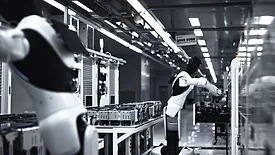
MUNICH—A new report by Roland Berger Strategy Consultants claims that recent advances in AI and humanoids wlll enable manufacturers to address the skilled labor shortage.
Overall, the United States-Mexico-Canada Agreement (USMCA) has been net positive for all three countries, and it has contributed to a dynamic, robust North American economy. However, the Trump Administration has indicated that without concessions from Mexico and Canada, the U.S. will not renew the agreement.
BIRMINGHAM, Mich. — Medline is highlighting the role of safety in manufacturing performance, naming three U.S. production facilities as winners of its 2025 Golden Cone Awards.
The system will automate a sequence of mechanical and electrical verification steps commonly required for complex handheld medical devices.
March 19, 2026
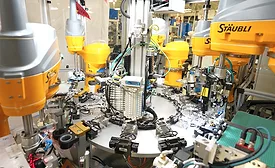
WESTBROOK, ME—Systems integrator Lanco has been awarded a contract to design and build an automated, pallet-based test system for high-volume production of a medical device.
Now, the cobot can weld one component while the operator replaces the completed part, minimizing downtime and maximizing output. By using one robot across multiple stations, PeyMar made the most of its limited floor space. It also reduced costs for labor, capital investment and maintenance.
The growing emphasis on green chemistry and the circular economy has redirected research toward sustainable adhesives, seeking materials that balance bonding performance with renewability, recyclability and reduced toxicity.
By choosing compatible specialty resins and copolymers rather than commodity plastics for laser-transparent and laser-absorbent layers, manufacturers can add value in terms of aesthetics, specific performance attributes, durability and regulatory compliance.
 RSS
RSS