All right, Christmas shoppers, be honest. Let’s say your spouse wants a new digital camera. You visit your local camera shop to seek advice from a knowledgeable clerk.
Manufacturing execution systems (MES) are critical elements of Industry 4.0. When all production processes are linked and synchronized with the overall operation, manufacturers have a strategic tool that enables them to improve productivity, streamline costs, boost quality and reduce time to market.
Many companies routinely hit capacity constraints and immediately consider adding overtime for existing workers, hiring workers for a new shift, or buying a new line. Relatively few companies have made the more modest investment that is required to optimize the performance of their existing lines.
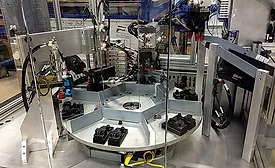
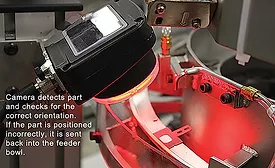
The manufacturer needed to present thin steel blades down an assembly line in a specific orientation. However, the parts were essentially symmetrical, with the exception of a small notch that had to be presented on the right side. With no real differences in the part other than this notch, feeding them to an assembly mechanism with 100 percent accuracy was a challenge.
The one constant thing about technology is that it is constantly changing and evolving. Don’t think so? In that case, ask the people who rushed out to buy the latest iteration of a smartphone, but then find themselves standing in line waiting to purchase the latest new-and-improved version just six months later.
Manufacturers of complex products, such as engines and transmissions, have long been using radio frequency identification (RFID) technology to error-proof their processes, document quality, and deal with high-mix production.
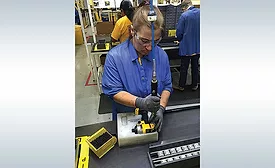
During a recent visit to this bright, open, state-of-the-art factory, I took a turn on the line assembling one of DEWALT’s hottest products, the 20-volt MAX XR three-speed cordless drill and screwdriver, which is powered by a brushless motor and a 5 amp-hour lithium-ion battery.