As the Industry 5.0 era transforms manufacturing, academic curriculums and research initiatives must evolve to meet new challenges, demands and opportunities.
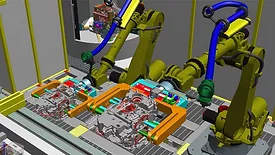
When introducing new vehicle models, each launch can demand extensive reconfiguration of existing production lines. Timing is critical and every delay carries a significant cost. Digital twin technology can help engineers tackle that issue.
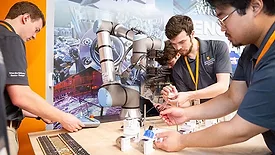
A team of young engineers at the University of Tennessee is using a six-axis collaborative robot to automate assembly steps such as terminal insertion and wire routing.
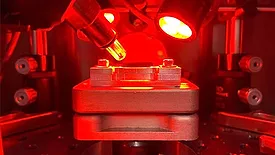
Researchers at Pennsylvania State University used large language models to evaluate parameters that can contribute to laser welding defects and quality issues.
They focused on gyroid infill, an intricate, repeating internal structure commonly employed in additive manufacturing to minimize weight while preserving structural integrity.
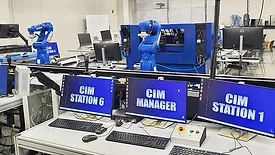
California Polytechnic State University recently opened a state-of-the-art smart manufacturing facility dedicated to hands-on education and applied research in industrial automation and robotics.
Engineers at the Whiting School of Engineering at Johns Hopkins University and the Johns Hopkins Applied Physics Laboratory (APL) are harnessing additive manufacturing and artificial intelligence technology to develop new ways to improve both the speed of production and the strength of titanium parts.
Engineers at Rice University are developing next-generation wearable devices that are smarter, lighter weight and more flexible than current alternatives.
The Baja SAE Carolina competition is a pinnacle event in automotive engineering, offering university students a unique platform to design, build, test and race rugged off-road vehicles.
 RSS
RSS