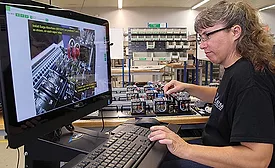
Optimizing flow and minimizing waste are two of the basic elements of lean manufacturing. Those concepts also play a critical role in laying out assembly lines.
During the next decade, more automakers will be adopting 48-volt electrical systems to keep up with evolving driver-assist options, onboard entertainment features and other power-sapping applications. Growing demand for mild-hybrid electric vehicles (MHEVs) is also behind the trend.
During the first five decades of commercial aviation, aircraft design changed dramatically. However, that hasn’t been the case over the last 50 years. Despite major developments in materials, the basic shape of commercial aircraft has remained relatively the same since the 1960s.
Maine has a long, proud history of producing boats and ships. The state is home to many small boatbuilders such as Back Cove Yachts, Hinckley Yachts, Hodgdon Yachts and Sabre Corp.
It has witnessed the production of some of the most iconic vehicles in history. It's also a veteran of two world wars and the Great Depression. And, it played a pivotal role in American labor history. Ford Motor Co.'s iconic manufacturing complex on the banks of the Rouge River in Dearborn, MI, has seen it all.
Carbon-fiber composite materials have been the darling of the aerospace industry in recent years. But, metal still plays a critical role in commercial and military aircraft, especially for applications that involve high temperatures or high stresses, such as engines and landing gear.
Recently, a startup Italian car company called XEV launched a two-seat electric vehicle. When it goes into production at a plant in Jiangsu, China, next month, the LXEV will become the world's first mass-produced printed car.
Traditionally, assemblers use semiautomated or manual tools to drive screws. While that technology is still used for some fastening applications, more manufacturers are investing in robotic screwdriving.
Robots have always struggled to match human touch. But, recent advances in sensor technology now enable machines to process the sensitive forces needed for delicate assembly tasks, such as placing, inserting and tightening parts.