New Products for Adhesive Bonding
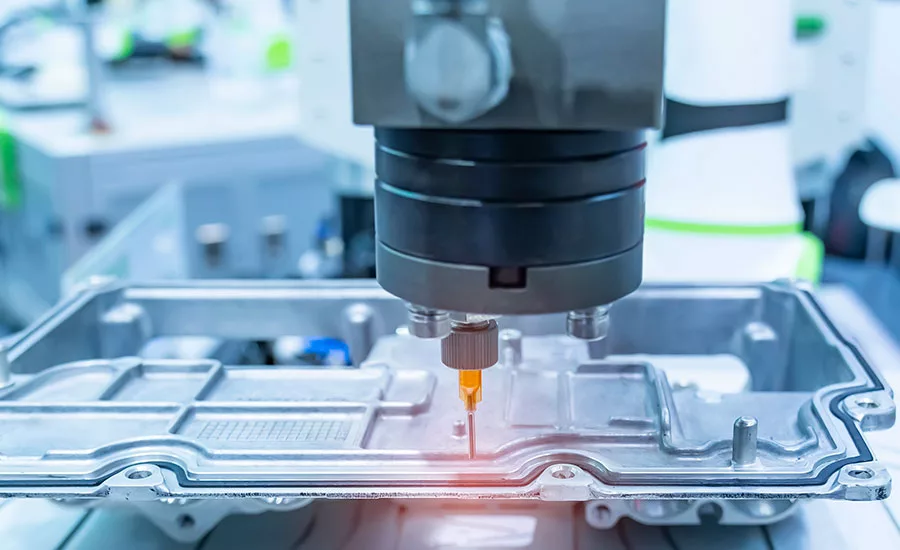
Photo: kynny / iStock / Getty Images Plus
Adhesives are used to assemble virtually every type of product, large or small. For example, the average car contains 33 to 60 pounds of adhesives, including thread-lockers, form-in-place gaskets, potting compounds and structural adhesives. Future vehicles will likely contain even more adhesives.
Here’s a look at the latest at the latest adhesives and the equipment to dispense and cure them.
Form-in-Place Gasket for Automotive Electronics

Loctite SI 5972FC is a one-part RTV silicone form-in-place gasket material for sealing electronic modules. With adhesion to a range of metal and plastic surfaces, the highly dispensable liquid silicone has been specifically designed to pass leak or blow-out pressure tests immediately after assembly, minimizing the need for time- and space-intensive staging. With its tin-free catalyst chemistry, Loctite SI 5972FC is also a REACH-compliant material for safer, more sustainable manufacturing.
The material can pass a 3-psi leak test immediately after assembly. Even higher leak test pressures can also be passed in relatively short periods. In addition, the material’s noncorrosive outgassing and low volatility make it ideal for use around sensitive electronic components. Recommended applications include electronic control units, bussed electric centers, battery disconnect units, electrical power steering power packs, and radar components.
See this company at The ASSEMBLY Show Oct. 22-24 in Rosemont, IL.
Henkel Corp.
https://next.henkel-adhesives.com
Adhesive for Biosensors

DELO Monopox MG3727 adhesive has been formulated specifically for assembling biosensors, such as electrodes for electrocardiograms. Since stainless steel is often central to the construction of such equipment, DELO ensured that the new adhesive performs well on that substrate, with a compression shear strength of 11 megapascals.
Looking for quick answers on assembly and manufacturing topics? Try Ask ASM, our new smart AI search tool. Ask ASM
The adhesive is based on a long-proven consumer electronics adhesive featuring low temperature curing and high drop resistance. However, Monopox MG3727 is not cytotoxic and meets all standards for a medical-grade adhesive.
This one-component, solvent-free and humidity-resistant adhesive features a low Young’s modulus of 160 megapascals, making it resistant to cracking under sudden impact, such as if a sensor falls to the ground. A low glass transition temperature of -52 C helps the adhesive retain its properties across the range of temperatures.
Monopox MG3727 takes 10 minutes to fully cure via a low heat of 90 C, making it optimal for temperature-sensitive substrates. With a viscosity of 30,000 millipascal-seconds, it can be easily applied via needle dispensing for optimal production efficiency. Blue fluorescence allows for increased process control of dispensing accuracy.
See this company at The ASSEMBLY Show Oct. 22-24 in Rosemont, IL.
DELO Industrial Adhesives
www.delo-adhesives.com
Adhesives, Sealants Are Biocompatible

EpoxySet offers an extensive line of biocompatible adhesives, sealants and potting materials that are approved to ISO-10993-5. Many of these products will withstand autoclave and ethylene oxide sterilization, so they can be used in a multitude of medical devices. Applications include sensors, PCBs, instruments, hearing aids, ultrasound probes, pacemakers, MRI machines, endoscopes and catheters.
Biocompatible products include EO-97M, Setworx-60, Flashbond UV-8300LV, and EB-153.
EO-97M is a one-component, silver-filled epoxy adhesive that has a wide range of cure profiles. At the recommended minimum temperature of 80 C, it will cure in several hours, but sensitive components will not be damaged. It is also possible to “snap cure” the epoxy at very high temperatures. This generally leads to higher shrinkage than curing at lower temperatures, but it can be advantageous for electrical and thermal conductivity by increasing contact of conductive fillers.
Setworx-60 is a toughened, high-strength, structural epoxy. It has an excellent combination of shear and peel strength. It has also excellent impact and vibration resistance and low-temperature flexibility. This nonhazardous, BPA-free epoxy exhibits very good physical, thermal and electrical insulation properties.
Flashbond UV-8300LV is a low-viscosity, light-curing epoxy that bonds well to a variety of substrates, including metals, glass, ceramics and some plastics. It exhibits good surface wetting and adhesion to glass and many plastics. This product requires direct light exposure during cure.
EB-153 is an unfilled, low-viscosity, heat-curing, high temperature resistant epoxy. It maintains high lap shear strength up to 210 C and has excellent thermal and chemical resistance. It can be used for bonding, coating and sealing applications where a thin film with high insulating resistance is required, particularly at elevated temperatures. It is recommended for bonding metals, glass, and ceramic substrates.
See this company at The ASSEMBLY Show Oct. 22-24 in Rosemont, IL.
EpoxySet Inc.
https://epoxysetinc.com
Low Out-Gassing Silicone for Spacecraft

SSP2575 is a 65-durometer silicone elastomer for low outgassing and low temperature applications in spacecraft. This product maintains its flexibility at temperatures as low as -116 C and passes ASTM E595 outgas testing with a total mass loss of 0.17 percent. This heat-cured material uses a Varox-peroxide catalyst system and can be supplied as a ready-to-mold compound, compression molded sheet stock, or custom molded parts. The silicone is black in color, but can be can pigmented to meet customer requirements.
Specialty Silicone Products Inc.
https://sspinc.com
Dual-Cure Adhesives

HLC adhesives combine the best attributes of anionic and free radical chemistries. HLC materials exhibit the physical and performance properties of standard light-curable materials and the rapid on-contact cure of anionics. The incorporation of contact curing allows these adhesives to be used with a larger range of substrates, including opaque and light-blocking materials, and ensures curing in dark areas not reachable by light.
The primary advantages of HLC adhesives include fast cure, low-to-no blooming after proper light cure, better aesthetics, humidity resistance, and more flexible joints than cyanoacrylates. Substrates don’t need to be translucent, and exposure to light curing increases the integrity of the bonds.
Dymax Corp.
dymax.com
Conveyorized Benchtop Dispensing Robot

The RC Series robot conveyor system streamlines the process of filling and handling molds with plastisol and other fluids. The system consists of a benchtop gantry robot with an integrated slip roller conveyor. The entire X-Y-Z motion system is located above the dispensing plane, straddling over the conveyor with a rigid structure. This modular design accommodates up to 16 valves, making it ideal for multiple color applications.
The system is preprogrammed and ready to run within minutes of uncrating. Motion paths may be directly imported from CAD and graphics programs and set up in Windows-based software. Alternatively, the system can be taught with an advanced jog and teach function, which draws the patterns on the screen while engineers teach it on the machine. Any file may be modified with a few mouse clicks. No programming experience is required.
Dispense Works Inc.
www.dispenseworks.com
Tapes for Appliance Assembly

Avery Dennison has introduced a portfolio of pressure-sensitive adhesives for the appliance industry. These easy-to-apply tapes have been designed to enhance durability and improve noise, vibration and harshness damping. The portfolio consists of 40 products for use in refrigerators, freezers, ovens, stovetops, dishwashers, dryers and washers.
Applications include mounting small parts, brand emblems, decorative items, and plastic trim for exterior applications; bonding gaskets; mounting evaporators and coils; adhering felt and foam materials used for noise and vibration damping; and attaching materials for heat dissipation.
The tapes have excellent quick stick, shear and foam bonding qualities. They bond to many common lamination materials, including felt, flock, foam, high-loft PET, and many batting materials. Tapes have been designed to resist heat, cold, moisture and chemicals.
Avery Dennison Performance Tapes
https://tapes.averydennison.com
Device Inspects Sealant and Adhesive Beads

The EyeVision Sealant Inspector is used to check the height, width and cross-section of adhesive and sealant beads. After engineers define tolerances for each parameter, the noncontact Inspector automatically and reliably detects deviations. The software creates a point cloud of the bead, enabling it to recognize the smallest deviations. The sensor can inspect both closed and open beads. All results are available in a database for documentation.
Eye Vision Technology GmbH
www.evt-web.com
Tapes for Medical Device Assembly

Three new tapes—TM8610, TM8650, TM1060 and TM1064—are designed for direct skin contact and tout a unique solvent-free acrylic adhesive known as Mactac MP-160. The specially formulated adhesive provides an excellent combination of long-term hold and gentle removal from skin. Double-sided tapes (TM8610 and TM8650) offer superior conformability in low and high adhesive thickness options. Transfer tapes (TM1060 and TM1064) feature 2- and 4-mil constructions, a robust release liner and excellent moisture-vapor transmission rates for applications requiring breathability.
Tapes remove from skin cleanly without causing irritation and are sterilizable, latex-free, biocompatible, and compatible with most drape materials. Medical products are independently tested following ISO-10993 guidelines and have a two-year shelf life.
Mactac
www.mactac.com
For more information on adhesives and dispensing equipment, read these articles:
What’s New With Epoxies
New Technology for Form-in-Place Gaskets
New Applications Increase Demand for Anaerobic Adhesives
Looking for a reprint of this article?
From high-res PDFs to custom plaques, order your copy today!