New Technology Enables Robots to Process Moving Parts
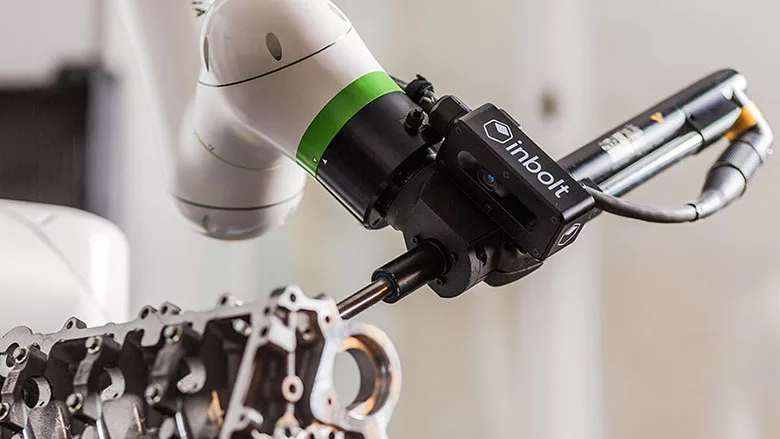
A new real-time guidance system uses artificial intelligence and 3D vision technology to help robots make decisions in unstructured environments.
Photo courtesy Inbolt
Traditionally, industrial robots interact with fixed parts and static workpieces. But, new technology recently developed in France enables six-axis robots to work on moving parts on assembly lines.
The system enables screw insertion, bolt rundown and other tasks that are challenging applications for traditional robotics. It also tackles real-world constraints such as crowded workstations, variable parts and variable part position.
That’s something that has been notoriously difficult for automation to accomplish in the past without massive infrastructure upgrades, expensive fixtures, cycle time compromises and constant maintenance.
A start-up company called Inbolt recently unveiled a real-time guidance system that uses artificial intelligence and 3D vision technology to enable robots to make autonomous decisions in uncertain and unstructured environments. Using a standard 3D camera, it enables robots to adapt to their environment, making automation more flexible, reliable and efficient.
General Motors was the first U.S. manufacturer to adopt the system in it is factories, while other companies, ranging from Airbus to Whirlpool, are also using Inbolt’s technology across various assembly applications.
“Processing moving parts is difficult, because traditional robots rely on static positioning,” says Albane Dersy, chief operating officer at Inbolt. “They need parts to be in the exact same place, every time.
“On moving lines, even slight shifts in speed, position or orientation can break the automation,” explains Dersy. “We solve this with a real-time 3D guidance system and an ultra-fast AI model that continuously updates the robot’s trajectory. This lets [machines] adapt to changing environments and maintain precision at full line speed.”
Looking for quick answers on assembly and manufacturing topics? Try Ask ASM, our new smart AI search tool. Ask ASM
Inbolt enhances quality by enabling robots to perform precision tasks like screw insertion or bolt rundown with consistently high accuracy, even when parts are moving or slightly misaligned. A real-time 3D vision-guidance system continuously monitors object position and orientation, so a robot can dynamically adjust its path. This reduces errors, rework and quality control issues caused by misalignment or variation on the line.

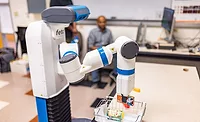
Robots can now perform material handling and other tasks on moving assembly lines. Photo courtesy Inbolt
“Our system can be used for adhesive dispensing, riveting, screwdriving or welding,” claims Dersy. “However, most of our customers are using it for pick-and-place applications, such as line loading and machine unloading.”
Dersy and her colleagues recently collaborated with engineers at Fanuc America Corp. and General Motors to develop a vision-based system that enables six-axis robots to think and act spontaneously.
“Our software takes over control of the machine’s trajectory at a very high frequency so that we can adapt to changing production environments found on continuously moving assembly lines,” says Dersy. “Robots such as Fanuc’s CRX cobot can operate with real-time 3D vision and adaptive trajectory correction, even with part variation or imperfect environments.”
GM is the first company to adopt the new technology, which relies on Fanuc’s Stream Motion real-time motion interface to enable a lightweight, robot-mounted vision system to take over the control of the machine’s path.
“Stream Motion allows external inputs to continuously update a robot’s trajectory via Ethernet,” explains Dersy. “What makes it powerful is its ability to support dynamic control loops. When paired with [our] guidance system, robots can adapt their motion live, enabling them to work on moving parts without stopping or reindexing.
“Like other large automakers, GM is attempting to automate the last frontier of automation, which is moving assembly lines,” notes Dersy. “But, doing that in a brownfield plant can be challenging, because it’s expensive to retrofit entire lines.
“Our primary goal is to reduce the complexity of automation,” says Dersy. “Using our technology, automakers can now automate some workstations and assembly tasks for productivity improvements.”
“This [system] gives car manufacturers a new level of automation: precision tasks performed by robots on lines that never stop,” adds Rudy Cohen, CEO of Inbolt. “No more expensive indexing. No more undue complexity and maintenance challenges. Just robots operating in a continuous motion environment and a huge leap forward for automakers’ general assembly shops.”
According to Cohen, Inbolt’s system operates up to 100 times faster than conventional options. “It’s also designed to scale across diverse production needs, whether for manufacturers worried about maintenance or line throughput, or system integrators’ requirements for easy and quick installation,” he points out.
Inbolt uses AI to interpret 3D vision data in real time.

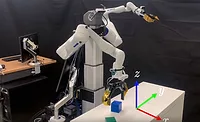
The vision-based system enables six-axis robots to think and act on the fly. Photo courtesy Inbolt
“Our localization model rapidly identifies the position and orientation of parts, even with variation or in cluttered environments, and updates the robot’s path on the fly,” explains Dersy. “The AI model is pretrained and then fine-tuned on CAD data, so it can recognize a wide range of part geometries and generalize across multiple references.
“Our Vision system is mounted directly on the robot and captures 3D data of the station in real time,” says Dersy. “This depth information is processed by AI to detect exact part positioning. Unlike traditional vision setups, there’s no need for fixed lighting or controlled environments. It works in variable, real-world conditions and enables robots to adapt in place.”
In the automotive industry, Inbolt is being deployed in various stationary workstations such as deracking in body shops to overcome challenges of misplaced parts to eliminate pick errors and downtime without the need for mechanical rework. It’s also being used in power train assembly plants for installing fasteners in engines and dispensing sealants.
“However, where Inbolt stands out is with final assembly lines, arguably the most challenging stage to automate due to constant movement and variability,” claims Dersy. “A typical use case here is screwdriving or bolt insertion on parts moving down the line, such as car doors. With manufacturers like Stellantis, we’re enabling robots to perform these tasks with precision and without stopping the line, something previously thought only a human could do.”
In addition to working with GM and Stellantis, Inbolt technology is in use at other automakers, such as Ford and Toyota, plus Tier One suppliers like Borg Warner and Magna. And, the company has been deploying its technology on robots made by companies other than Fanuc, including ABB, Kawasaki, Kuka and UR.
For more information on assembly robots, read these articles:
Looking for a reprint of this article?
From high-res PDFs to custom plaques, order your copy today!