Assembly Magazine logo
search
Ask ASSEMBLY AI
cart
facebook twitter linkedin youtube
  • Sign In
  • Create Account
  • Sign Out
  • My Account
Assembly Magazine logo
  • TRENDS
    • Ask ASSEMBLY AI
    • Trends
    • News
    • New Products
  • INDUSTRIES
    • Aerospace
    • Appliance
    • DFMA Assembly
    • Medical Devices
    • Green Manufacturing
    • Lean Manufacturing
    • Machinery Assembly
    • Electronics Assembly
    • Automotive
  • TECHNOLOGIES
    • Adhesives & Dispensing
    • Assembly Presses
    • Automated Assembly Systems
    • Manufacturing Management
    • Manufacturing Software
    • Motion Control
    • Screwdriving & Riveting
    • Robotics
    • Test & Inspection
    • Plastics & Metal Welding
    • Wire Processing
    • Workstations
  • AUTONOMOUS & ELECTRIC MOBILITY
    • AEM Magazine Archives
    • Autonomy
    • Electrification
    • Mobility Services
    • Assembly & Testing
    • AV/EM News
  • MEDIA
    • Ask ASSEMBLY AI
    • Podcasts
    • Assembly News Now
    • Assembly TV
    • Webinars
    • eBooks
  • EVENTS
    • Calendar
    • The ASSEMBLY Show
  • MORE
    • Exclusives >
      • Plant of the Year
      • Capital Spending
    • Buyers Guide >
      • Supplier Insights
    • Classifieds
    • Featured Products
    • Newsletters
    • Store
    • White Papers
    • Columns
    • Sponsor Insights
  • INFOCENTER
    • Assembly & Test Solutions
  • EMAGAZINE
    • eMagazine
    • Archive Issues
    • Advertise
    • Contact Us
    • Sign Up
TechnologiesAerospace AssemblyAdhesives & Dispensing AssemblyAutomated Assembly SystemsRobotics Assembly

Robots Coordinate for Aerospace Assembly
By John Sprovieri
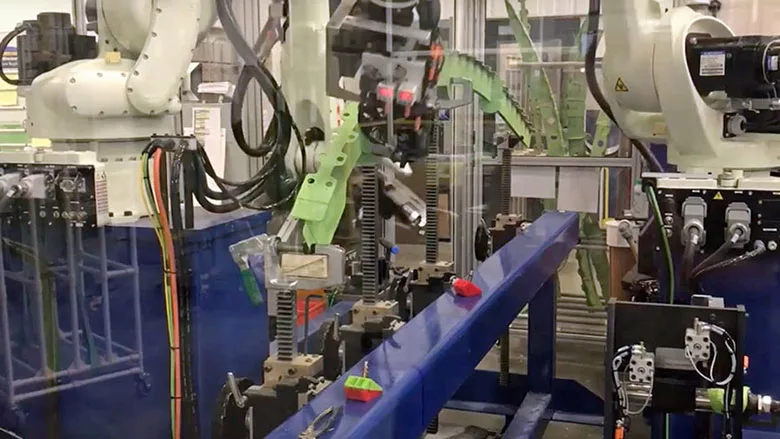
six-axis robots rivet nut plates onto a fuselage component
Photo courtesy Kawasaki Robotics

Two six-axis robots cooperate to rivet nut plates onto a fuselage component for an airplane.

Photo courtesy Kawasaki Robotics

July 2, 2025

Traditionally, aircraft assembly has been a labor-intensive, manual process. Robots have been a rare sight in aerospace manufacturing due to low production volumes and highly specialized parts.

That’s beginning to change, however. Robots are slowly becoming a key part of military and commercial aircraft assembly lines as the aerospace industry adopts new materials, grapples with throughput issues, and addresses ergonomic concerns and skilled labor shortages.

Such was the case when an aerospace supplier approached Canadian systems integrator Samuel Automation for help with a difficult assembly process. Based in Waterloo, Ontario, Samuel Automation was asked to design a complex robotic assembly cell for installing nut plates in aerospace components.

robot drills and countersinks holes in an aircraft component

A robot drills and countersinks holes in an aircraft component. Photo courtesy Kawasaki Robotics

The nut plates are an irregular part with more than 200 variations. The fasteners are used to hold the external skin of the aircraft to the frame.

There were multiple reasons why the supplier wanted to automate the process of nut plate installation. For starters, to meet strict quality requirements, all employees had to undergo intensive training and certification for each part. They also had to document their work in real time. This, combined with the monotonous nature of the installation process, created employee retention issues for the manufacturer.

Quality control was another issue. Nut plates play an integral role in aircraft construction. The rivets used to secure the nut plates must be precisely installed. The rivet heights must be exact. Prior to automation, workers had to shave the rivets to the exact height needed, a tedious and time-consuming process.

Although this complex application did not necessarily sound like an ideal candidate for automation, Samuel Automation thought differently. Samuel engineers believed they could automate the process with vision-guided six-axis robots.

Looking for quick answers on assembly and manufacturing topics? Try Ask ASM, our new smart AI search tool. Ask ASM →
 

Kawasaki’s R Series robots

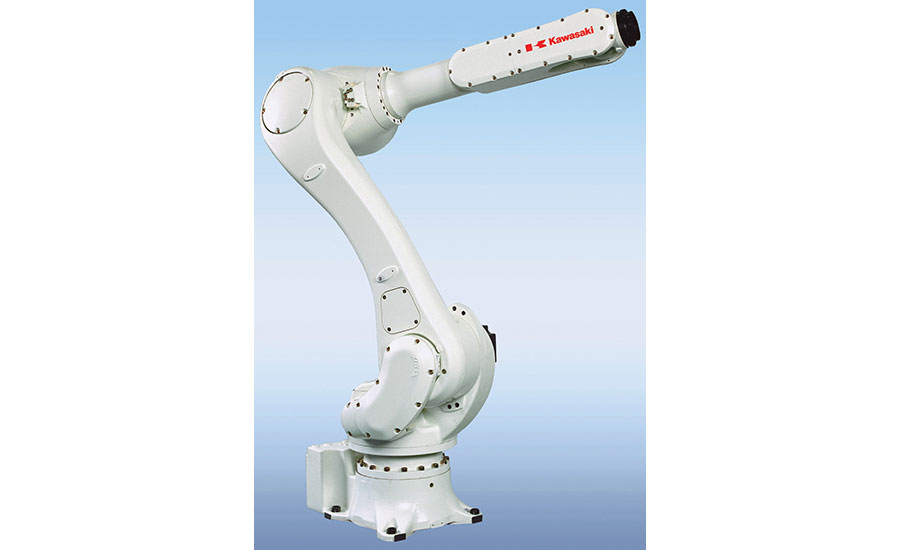
Kawasaki’s R Series robots are designed for applications requiring a long reach and small- to midsized payloads. Photo courtesy Kawasaki Robotics

Robotic Assembly Cell

Samuel Automation designed an automated assembly cell featuring three six-axis robots from Kawasaki Robotics. Vision systems locate and identify 225 part types.

At the first station, a Kawasaki RS080N robot determines the position of the base part by scanning three distinctive features using 3D vision and adjusting its position accordingly. The robot is equipped with a multipurpose end-of-arm tool (EAOT). One side is for drilling; the other side is for riveting.

After alignment, the RS080N’s EOAT grips the base part, then drills and countersinks two holes for the rivets that will be used to secure the nut plate.

Next, the robot rotates to retrieve the rivets for the assembly. There are four lengths to choose from, depending on the size of the plate.

While the RS080N is getting the rivets, a second robot—an RS010L—picks up a nut plate. A vision system verifies that it is the correct part. (There are 28 possible types.)  The robot then places the nut plate in a special custom fixture. The fixture is designed to help the robot locate the nut plate accurately on the base part. A vision system checks the fixture to ensure it is clear to receive the nut plate.

vision system tells the robot the exact location of an airplane component

A vision system tells the robot the exactly location of this airplane component. Photo courtesy Kawasaki Robotics

Next, the RS010L places the nut plate and fixture assembly onto a turntable so a third robot—an RS005N—can apply sealant to help protect against corrosion. The RS005N conducts two vision checks: one before and one after sealant application. 

Then, the turntable rotates so the RS010L can pick up the nut plate and fixture assembly and place it onto the base part. Prior to placement, the robot scans the base part to determine its exact position. While the RS010L robot holds the nut plate in place, the RS080N robot enters the area and the two heads marry to install the rivets.

After rivet installation, the robot heads separate. The RS010L safely releases the part and rotates to drop off the fixture. The RS080N rotates its EOAT to the correct position for rivet crimping, which completes the 39-second process.

Each robot has a different reach and payload capacity. The RS080N has a maximum reach of 2,100 millimeters and can carry a maximum payload of 80 kilograms. Positional repeatability is ±0.06 millimeter. The RS010L has a maximum reach of 1,925 millimeters and can carry a maximum payload of 10 kilograms. Positional repeatability is ±0.05 millimeter. The RS005N has a maximum reach of 705 millimeters and can carry a maximum payload of 3 kilograms. Positional repeatability is ±0.02 millimeter.

Samuel Automation chose Kawasaki robots because of their open architecture programming language and their ability to handle advanced processes.

A unique aspect of this application is how closely the robots work together. The heads of the RS080N and the RS010L must connect without colliding, an action that’s impossible without highly repeatable robots. Kawasaki’s R series of general purpose robots fit this criteria, with repeatability ranging from ±0.02 to ±0.06 millimeter as payload increases (3 to 80 kilograms).

The cell has been a success by many measures. Cycle time was reduced by 26 seconds, and the number of operators reduced from three to one. The cell creates a fully complete assembly; no work-in-progress stations are needed.

For more information on automated assembly systems, visit www.samuelautomation.com. For more information on industrial robots, visit https://kawasakirobotics.com.

See more articles from our July 2025 issue!


For more information on automation in aerospace manufacturing, read these articles:
High-Flying Robots
Robots Play a Key Role in F-35 Assembly
Assembly Automation Takes Off in Aerospace Industry

KEYWORDS: factory automation flexible assembly machine vision systems National Robotics Week robotic dispensing

Share This Story

Looking for a reprint of this article?
From high-res PDFs to custom plaques, order your copy today!

John has been with ASSEMBLY magazine since February 1997. John was formerly with a national medical news magazine, and has written for Pathology Today and the Green Bay Press-Gazette. John holds a B.A. in journalism from Northwestern University, Medill School of Journalism.

Recommended Content

JOIN TODAY
To unlock your recommendations.

Already have an account? Sign In

  • Made in the U.S.A.

    Consumer Products Manufacturing: Made in the USA

    Supply chain lessons learned during the coronavirus...
    Automated Assembly Systems
    By: Austin Weber
  • Best Practices for Press-Fit Assembly

    Best Practices for Press-Fit Assembly

    In manufacturing, ironclad formulas for success are hard...
    Assembly Presses
    By: Jim Camillo
  • aem0523leader-tesla1.jpg

    Tesla Rethinks the Assembly Line

    Engineers at Tesla Inc. have developed a new process that...
    Industries
    By: Austin Weber
Manage My Account
  • eMagazine Subscription
  • Assembly Newsletters
  • Online Registration
  • Subscription Customer Service
  • Manage My Preferences

More Videos

Sponsored Content

Sponsored Content is a special paid section where industry companies provide high quality, objective, non-commercial content around topics of interest to the ASSEMBLY audience. All Sponsored Content is supplied by the advertising company and any opinions expressed in this article are those of the author and not necessarily reflect the views of ASSEMBLY or its parent company, BNP Media. Interested in participating in our Sponsored Content section? Contact your local rep!

close
  • ultrasonic welding
    Sponsored bySonobond Ultrasonics

    Engineering Efficiency in High-Performance Assembly: How Ultrasonic Welding Enhances Throughput, Reliability and Quality

  • UV curing system
    Sponsored byDymax

    Why UV Intensity Alone Doesn’t Define Curing Performance

  • wooden pallets
    Sponsored byLEAN Manufacturing Products

    Eliminating Waste on the Shop Floor: Applying Lean Principles to Improve Manufacturing Efficiency

Popular Stories

ASSEMBLY News Now, episode-30: Volvo Redesigns EV Manufacturing

Volvo Redesigns EV Manufacturing

Boeing CEO Kelly Ortberg announces 1 billion investment

Boeing Plans $1 Billion Wichita Investment, Workforce Training Center

automated consumer goods assembly system

Best Practices for Cycle Time Optimization

Watch the latest episode of ANN now!

Events

July 24, 2025

From Shop Floor to CFO: How Manufacturers Are Closing the Loop Between Operations and Finance

On Demand Learn how manufacturers are bridging the gap between the shop floor and ERP systems to gain real-time visibility, streamline operations, and kick-start digital transformation—without waiting years.

Sponsored by:

PicoStratusGreen
July 30, 2025

Buffer Analysis and Design Fundamentals for Manufacturing Excellence

On Demand In this presentation, Dr. Herman Tang shares practical insights from his industry experience and research on buffer management in manufacturing operations.

View All Submit An Event

Poll

Difficult Assembly Processes

Which assembly process gives you the most difficulty?
View Results Poll Archive

Products

Manufacturing Cost Policy Deployment (MCPD) Profitability Scenarios: Systematic and Systemic Improvement of Manufacturing Costs

Manufacturing Cost Policy Deployment (MCPD) Profitability Scenarios: Systematic and Systemic Improvement of Manufacturing Costs

See More Products
Register for webinar - Modernizing Automotive Assembly: Why Upgrading Legacy MES is a Business Imperative

Related Articles

  • The Skies Are Clearing for Aerospace Assembly

    See More
  • PSAs for Aerospace Assembly

    PSAs for Aerospace Assembly

    See More
  • asb1122manip2.jpg

    Autonomous Mobile Manipulators for Aerospace Assembly

    See More

Related Products

See More Products
  • 2020 feb assembly

    ASSEMBLY February 2020 Issue

  • Product Design for Manufacture and Assembly, Third Edition

See More Products

Related Directories

  • Ascent Aerospace

    Ascent Aerospace is a world renowned, single-source provider of production and automated assembly systems for the aerospace, defense and space industries. As an automation provider and production system integrator, Ascent works with customers to develop their project and see it through from process engineering, to build and installation.
  • YRG Robotics

  • One-Off Robotics

    One-Off Robotics is an advanced equipment manufacturer designing and building the world's most innovative robotic fabrication systems. We specialize in robotic metal additive manufacturing and robotic milling, offering both stationary and portable, field-deployable systems engineered for demanding production environments. Our technologies enable additive, subtractive, and hybrid fabrication processes, supporting applications across Defense, Aerospace, Research, and Specialized Production sectors.
×

Never miss the latest news and trends driving the manufacturing industry

Stay in the know on the latest assembly trends.

JOIN TODAY!
  • RESOURCES
    • Advertise
    • Contact Us
    • Directories
    • Manufacturing Division
    • Store
    • Want More?
  • SIGN UP TODAY
    • Create Account
    • eMagazine
    • Newsletters
    • Customer Service
    • Manage Preferences
  • SERVICES
    • Marketing Services
    • Reprints
    • Market Research
    • List Rental
    • Survey/Respondent Access
  • STAY CONNECTED
    • LinkedIn
    • Facebook
    • Instagram
    • YouTube
    • X (Twitter)
  • PRIVACY
    • PRIVACY POLICY
    • TERMS & CONDITIONS
    • DO NOT SELL MY PERSONAL INFORMATION
    • PRIVACY REQUEST
    • ACCESSIBILITY

Copyright ©2026. All Rights Reserved BNP Media, Inc. and BNP Media II, LLC.

Design, CMS, Hosting & Web Development :: ePublishing