My first column talked about why manufacturing matters most for our country. This month, I want to discuss how chasing cheap prices is not only hollowing out domestic manufacturing but, in many cases, it’s making the companies that offshore less profitable. For decades, consultants and MBAs have told companies to focus on their core competencies—mostly R&D, finance and marketing—and outsource manufacturing offshore. Now, companies are discovering that strategy was often wrong.
Instant, reliable communication amongst plant managers is essential for them to coordinate and optimize their facility’s productivity and efficiency. Even a slight delay in relaying information can prevent a company from achieving these goals, especially if the delay results in unplanned downtime for equipment retooling or maintenance.
A few years ago, Brian Gattman, senior mechanical engineer at Fluke Corp., faced a big problem when designing the company’s new handheld TI400 thermal imaging camera. The off-the-shelf bearings he wanted to use in it were too big and had a too-high coefficient of friction. By working closely with the supplier, however, he was able to have the bearings custom made to meet both design specifications.
ARaymond Automotive has provided custom fasteners, clips, connectors, adhesives and other materials to OEMs and Tier 1 suppliers around the world for nearly 20 years. Its engineers specialize in three processes (fastening, fluid connections and bonding) that are used in all areas of a vehicle.
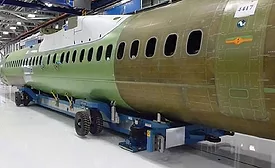
Aircraft manufacturing has changed significantly in recent years. Instead of being assembled in one spot, most aircraft today are built on moving assembly lines similar to those used by automakers. Despite this evolution, however, many aerospace manufacturers still rely on hydraulic jacks, tuggers or overhead cranes to move aircraft through the various manufacturing stages.
McKinsey & Co. surveyed more than 365,000 employees at 161 companies worldwide. The survey assessed how various organizational and leadership characteristics affect a company’s health.
It’s not unusual to find alternative lifestyle activities on or around college campuses. But, at Georgia’s Kennesaw State University, the word “alternative” refers to new types of energy systems.
When pilots fly the Boeing Co. Dreamliner 787-9 over Utah, they probably don’t point out to passengers the headquarters of Orbital ATK’s aerospace structures division (ASD) in the town of Clearfield. Nevertheless, it’s safe to assume they’re happy the facility is there.
Although being part of an international conglomerate has its advantages (such as extensive financial resources and access to cutting-edge technologies), a company still must make good products to establish and expand its customer base. This statement definitely applies to Canadian bus manufacturer Nova Bus Inc., which began in 1993 and has been part of Volvo Bus Corp.—the world’s largest motorcoach and transit bus manufacturer—since 1998.
Product designers, like manufacturers, face the daily challenge of creating original, quality products that fit market needs. Based in Dublin, the Klickity Co. has been meeting this challenge as both a product design firm and a manufacturer since 2010. Founded by industrial designer Kate Cronin, the company specializes in sustainable and affordable contemporary home accessories and LED-based gifts.
 RSS
RSS