Assembly Magazine logo
search
Ask ASSEMBLY AI
cart
facebook twitter linkedin youtube
  • Sign In
  • Create Account
  • Sign Out
  • My Account
Assembly Magazine logo
  • TRENDS
    • Ask ASSEMBLY AI
    • Trends
    • News
    • New Products
  • INDUSTRIES
    • Aerospace
    • Appliance
    • DFMA Assembly
    • Medical Devices
    • Green Manufacturing
    • Lean Manufacturing
    • Machinery Assembly
    • Electronics Assembly
    • Automotive
  • TECHNOLOGIES
    • Adhesives & Dispensing
    • Assembly Presses
    • Automated Assembly Systems
    • Manufacturing Management
    • Manufacturing Software
    • Motion Control
    • Screwdriving & Riveting
    • Robotics
    • Test & Inspection
    • Plastics & Metal Welding
    • Wire Processing
    • Workstations
  • AUTONOMOUS & ELECTRIC MOBILITY
    • AEM Magazine Archives
    • Autonomy
    • Electrification
    • Mobility Services
    • Assembly & Testing
    • AV/EM News
  • MEDIA
    • Ask ASSEMBLY AI
    • Podcasts
    • Assembly News Now
    • Assembly TV
    • Webinars
    • eBooks
  • EVENTS
    • Calendar
    • The ASSEMBLY Show
  • MORE
    • Exclusives >
      • Plant of the Year
      • Capital Spending
    • Buyers Guide >
      • Supplier Insights
    • Classifieds
    • Featured Products
    • Newsletters
    • Store
    • White Papers
    • Columns
    • Sponsor Insights
  • INFOCENTER
    • Assembly & Test Solutions
  • EMAGAZINE
    • eMagazine
    • Archive Issues
    • Advertise
    • Contact Us
    • Sign Up
TechnologiesColumnsManufacturing SoftwareAutomated Assembly SystemsRobotics AssemblyThe Editorial

Are You Ready for the Future? Asian Manufacturers Are
By John Sprovieri
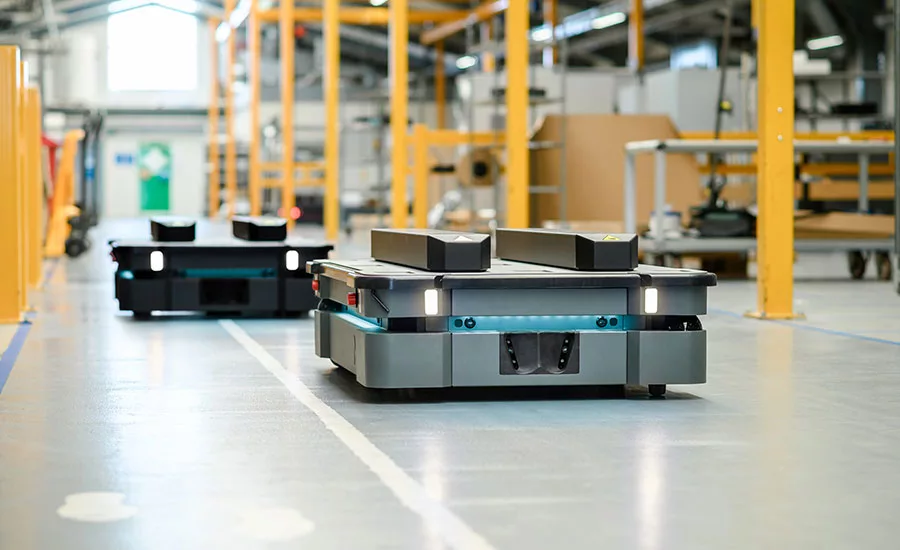
autonomous mobile robots

Autonomous mobile robots are among the “hyper-automation” technologies that could someday lead to “lights-out” factories.

Photo courtesy Teradyne
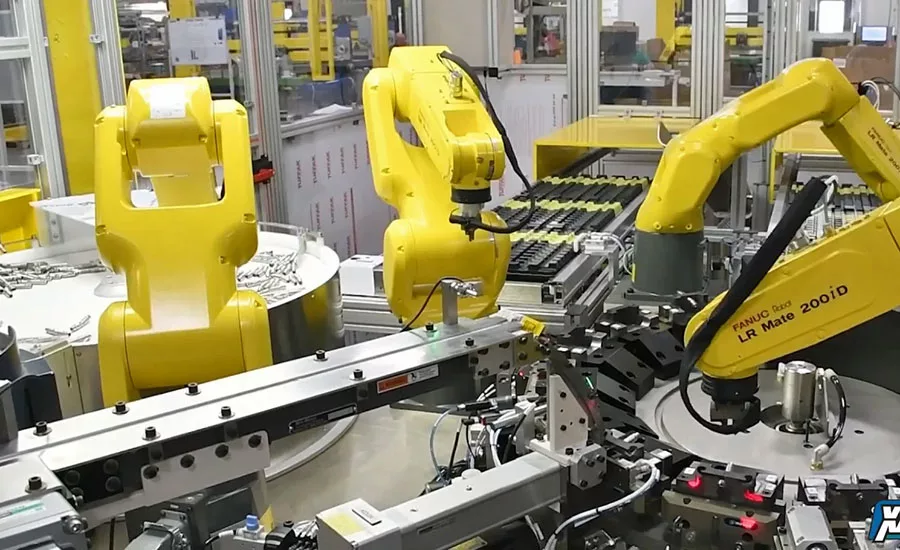
industrial production

In the factories of the future, AI will govern industrial production in real-time and static production lines will be a thing of the past.

Photo courtesy FANUC Corp.

autonomous mobile robots
industrial production
May 21, 2025

Factory managers in Asia are bullish that, by 2040, factories will rely almost completely on AI-enabled self-learning machines and robots, overseen and assisted by human workers. Their peers in Europe and the U.S. are more cautious, but agree the future of manufacturing will look quite differently from today.

These are findings from Accenture’s new report, Rethinking the Course to Manufacturing’s Future. Accenture surveyed 552 factory managers in Asia (China, India, Japan), Europe (Austria, Denmark, Finland, France, Germany, Italy and Switzerland) and the U.S. in December 2024. The respondents represent various industries, including automotive OEMs and parts suppliers, aerospace OEMs and parts suppliers, machinery manufacturers, electrical equipment manufacturers, and heavy equipment manufacturers.

According to the report, AI, automation and digital technologies will become increasingly important in manufacturing. Approximately half of the respondents stated that, by 2040, hyper-automated factories will rely on the following elements, which provide more agility and flexibility while enabling a step change in productivity:

  • Autonomous operations (53 percent).
  • Self-learning machines using generative AI (52 percent).
  • Completely automated warehouses (51 percent).
  • Smart connected manufacturing cells (49 percent).
  • Autonomous mobile robots (49 percent).
  • Digitally connected crews (48 percent).
  • Digital twins (47 percent).
  • Automated guided vehicles (45 percent).

“In the factories of the future, AI will govern industrial production in real-time and static production lines will be a thing of the past,” predicts Patrick Vollmer, global industry group lead for industrials at Accenture. “Digital twins will simulate the outcomes of every decision before it is executed, and humanoid robots will work alongside workers. Manufacturers won’t be debating automation, AI or digitalization—those will be the baseline.”

Between 51 percent and 83 percent of the factory managers in China and Japan agreed with these statements—considerably more than in the U.S., where only 31 percent to 50 percent said future factories would feature these technologies and application. In Europe, even fewer respondents (25 percent to 39 percent) believe these technologies and applications will be part of production sites by 2040.

The more futuristic and advanced the concept, the more marked the regional differences: 

74 percent of factory managers in Japan stated that, by 2040, their companies will prefer “dark factories” when building new facilities (China: 53 percent, U.S.: 29 percent, Europe: 20 percent).

At the same time, humanoid robots will be standard in their companies’ assembly processes, 72 percent of respondents in Japan claimed (China: 65 percent; U.S.: 35 percent, Europe: 21 percent).

Looking for quick answers on assembly and manufacturing topics? Try Ask ASM, our new smart AI search tool. Ask ASM →

“Manufacturers in Asia are paving the way for hyper-automated manufacturing and will likely benefit sooner from the competitive advantages it brings,” says Vollmer. “Companies in Europe and the U.S. take a more measured approach, in part because they build fewer new sites and existing factories are harder to transform. But this must not keep them from setting the course for hyper-automation today, not least since finding enough qualified workers will get only harder.” 

Hyper-automated factories will change how people work, the roles they take on, and the skills they need to be successful in these roles. Accordingly, almost three in four factory managers (70 percent) said “workforce transformation” is a critical enabler of hyper-automated manufacturing, even more than automation (63 percent), AI (62 percent) and digitalization (61 percent). 

How does the workforce need to change? According to most factory managers, it is in how production knowledge is preserved and shared (74 percent). They also stressed the importance of data-driven decision making (72 percent) and asserted that data analytics must become part of workers’ day-to-day work (73 percent).

Almost half (49 percent) of the respondents said the main barrier to workforce transformation are significant investments in training programs. Other barriers are people’s fear of losing their jobs (46 percent) and workers’ resistance to adapting to expanded roles (38 percent), such as human-robot collaboration manager and autonomous logistics coordinator. 

Factory managers also complain about a lack of professionals with AI skills and qualifications (51 percent), which they feel most keenly in India and Japan (67 percent in both cases) and less urgently in China (40 percent).

“By 2040, most workers will no longer work in production, they will work for production,” explains Vollmer. “This means they will have moved from manual labor to process oversight, decision-making and optimization. They will need to be comfortable collaborating with AI and operating autonomous systems. Manufacturers should help their workforce develop the required skills, which are scarce and will likely continue to be.”

Most factory managers are focusing on digitalization measures that should, arguably, already be in place. By far their highest priorities are cyber security measures (77 percent), followed by the implementation of manufacturing execution systems (70 percent) and cloud platforms (67 percent). 

Technologies that aren’t among factory managers’ top five priorities include IIoT and digital twins of machines and products, the exception being Japan and China. This is worrisome, according to the study, because these technologies are the digital foundations of the modern factory. 

What do you think? Is “lights-out automation” a pipe dream or an achievable goal? Is it even worthwhile? Clearly, Asian manufacturers see a future for the technology. That’s ironic, since neither China nor India necessarily need automation. The two countries have a combined population of 2.8 billion. Manufacturers there can simply continue to “throw bodies” at production. 

The hesitancy in the West is more puzzling. Manufacturers here have every incentive to invest in automation and yet a healthy skepticism prevails. Perhaps we’re jaded by technologies that have overpromised and under-delivered. It’s also worth noting that the survey did not include manufacturers of medical devices, consumer products and other high-volume goods.

We urge U.S. manufacturers to keep an open mind about so-called hyper-automation and invest in the technologies where and when they make sense. Our overseas competition is.

See more articles from our June 2025 issue!

KEYWORDS: Artificial Intelligence (AI) digital twin Industry 4.0 lights-out factory machine learning

Share This Story

Looking for a reprint of this article?
From high-res PDFs to custom plaques, order your copy today!

John has been with ASSEMBLY magazine since February 1997. John was formerly with a national medical news magazine, and has written for Pathology Today and the Green Bay Press-Gazette. John holds a B.A. in journalism from Northwestern University, Medill School of Journalism.

Recommended Content

JOIN TODAY
To unlock your recommendations.

Already have an account? Sign In

  • Made in the U.S.A.

    Consumer Products Manufacturing: Made in the USA

    Supply chain lessons learned during the coronavirus...
    Automated Assembly Systems
    By: Austin Weber
  • Best Practices for Press-Fit Assembly

    Best Practices for Press-Fit Assembly

    In manufacturing, ironclad formulas for success are hard...
    Assembly Presses
    By: Jim Camillo
  • aem0523leader-tesla1.jpg

    Tesla Rethinks the Assembly Line

    Engineers at Tesla Inc. have developed a new process that...
    Industries
    By: Austin Weber
Manage My Account
  • eMagazine Subscription
  • Assembly Newsletters
  • Online Registration
  • Subscription Customer Service
  • Manage My Preferences

More Videos

Sponsored Content

Sponsored Content is a special paid section where industry companies provide high quality, objective, non-commercial content around topics of interest to the ASSEMBLY audience. All Sponsored Content is supplied by the advertising company and any opinions expressed in this article are those of the author and not necessarily reflect the views of ASSEMBLY or its parent company, BNP Media. Interested in participating in our Sponsored Content section? Contact your local rep!

close
  • ultrasonic welding
    Sponsored bySonobond Ultrasonics

    Engineering Efficiency in High-Performance Assembly: How Ultrasonic Welding Enhances Throughput, Reliability and Quality

  • UV curing system
    Sponsored byDymax

    Why UV Intensity Alone Doesn’t Define Curing Performance

  • wooden pallets
    Sponsored byLEAN Manufacturing Products

    Eliminating Waste on the Shop Floor: Applying Lean Principles to Improve Manufacturing Efficiency

Popular Stories

ASSEMBLY News Now, episode-30: Volvo Redesigns EV Manufacturing

Volvo Redesigns EV Manufacturing

Boeing CEO Kelly Ortberg announces 1 billion investment

Boeing Plans $1 Billion Wichita Investment, Workforce Training Center

GE Appliances Worker on Line

GE Appliances Expands Factory AI With 800 Gemini Enterprise Agents

Watch the latest episode of ANN now!

Events

July 24, 2025

From Shop Floor to CFO: How Manufacturers Are Closing the Loop Between Operations and Finance

On Demand Learn how manufacturers are bridging the gap between the shop floor and ERP systems to gain real-time visibility, streamline operations, and kick-start digital transformation—without waiting years.

Sponsored by:

PicoStratusGreen
July 30, 2025

Buffer Analysis and Design Fundamentals for Manufacturing Excellence

On Demand In this presentation, Dr. Herman Tang shares practical insights from his industry experience and research on buffer management in manufacturing operations.

View All Submit An Event

Poll

Difficult Assembly Processes

Which assembly process gives you the most difficulty?
View Results Poll Archive

Products

Manufacturing Cost Policy Deployment (MCPD) Profitability Scenarios: Systematic and Systemic Improvement of Manufacturing Costs

Manufacturing Cost Policy Deployment (MCPD) Profitability Scenarios: Systematic and Systemic Improvement of Manufacturing Costs

See More Products
Register for webinar - Modernizing Automotive Assembly: Why Upgrading Legacy MES is a Business Imperative

Related Articles

  • Are you ready for Industry 4.0?

    See More
  • Are You Ready for Embedded Passives?

    See More
  • ASSEMBLY Audible: Are You Ready for Consumer-Driven Manufacturing?

    Are You Ready for Consumer-Driven Manufacturing?

    See More

Related Products

See More Products
  • smart.jpg

    Handbook of Smart Manufacturing Forecasting the Future of Industry 4.0

  • processind.jpg

    Digital Transformation for the Process Industries

  • The First Snap-Fit Handbook 2e: Creating and Managing Attachments for Plastics Parts

See More Products

Events

View AllSubmit An Event
  • July 24, 2025

    From Shop Floor to CFO: How Manufacturers Are Closing the Loop Between Operations and Finance

    On Demand Learn how manufacturers are bridging the gap between the shop floor and ERP systems to gain real-time visibility, streamline operations, and kick-start digital transformation—without waiting years.Sponsored by:
  • August 20, 2025

    K.I.S.S. MES (Keep It Simple, Stupid): Why Modern Manufacturers Are Choosing Modular MES with Real Shop Floor Control

    On Demand If you’re tired of MES that overpromises and underdelivers, it’s time to simplify. Learn how a modular approach gives you control where it counts—without the baggage.Sponsored by:
View AllSubmit An Event

Related Directories

  • ARS srl

  • Scope AR

×

Never miss the latest news and trends driving the manufacturing industry

Stay in the know on the latest assembly trends.

JOIN TODAY!
  • RESOURCES
    • Advertise
    • Contact Us
    • Directories
    • Manufacturing Division
    • Store
    • Want More?
  • SIGN UP TODAY
    • Create Account
    • eMagazine
    • Newsletters
    • Customer Service
    • Manage Preferences
  • SERVICES
    • Marketing Services
    • Reprints
    • Market Research
    • List Rental
    • Survey/Respondent Access
  • STAY CONNECTED
    • LinkedIn
    • Facebook
    • Instagram
    • YouTube
    • X (Twitter)
  • PRIVACY
    • PRIVACY POLICY
    • TERMS & CONDITIONS
    • DO NOT SELL MY PERSONAL INFORMATION
    • PRIVACY REQUEST
    • ACCESSIBILITY

Copyright ©2026. All Rights Reserved BNP Media, Inc. and BNP Media II, LLC.

Design, CMS, Hosting & Web Development :: ePublishing