Cobot Boosts Productivity at Contract Manufacturer
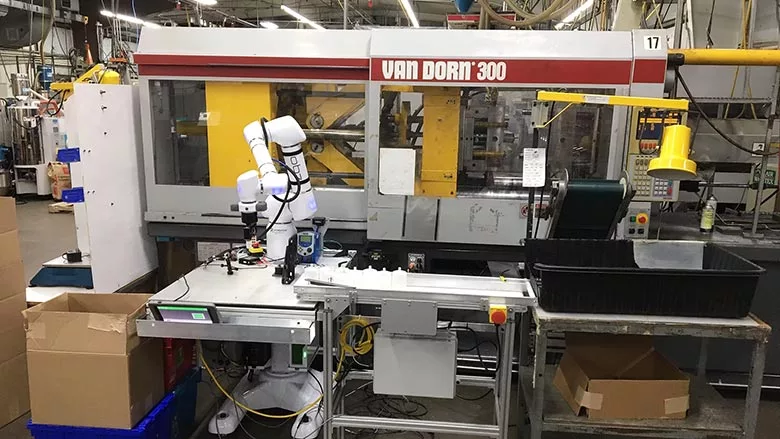
Shop-floor personnel were involved with the cobot from the moment it was uncrated. After going through a few trial runs, employees gained trust in the machine and its capabilities.
Photo courtesy Productive Robotics
Action Plastics Inc. was established in 1981 in Rogers, MN, with an emphasis on customer service in injection molding. Some 44 years later, that emphasis hasn’t changed.
Action Plastics molds parts for a variety of industries, primarily in the power sports, medical, and food and beverage sectors. From prototyping to full production, the company takes the time to understand its customers’ products and their unique needs. Its services include molding simulations and optimization, preproduction mold and process validation, production launch quality control, supply chain management, tooling repair, kitting and assembly.
Whether it’s a low-volume run or an order for more than 1 million parts, Action Plastics is well-equipped to handle any project. The company operates 28 hydraulic and electric molding presses ranging in size from 22 to 390 tons. In addition, the company’s factory is equipped with gravimetric feeders, automated conveyors, and equipment to regrind and recycle plastic. The facility also includes a clean room.
Recently, company engineers saw an opportunity to increase productivity by automating mid-volume assembly and production processes that depended on manual labor. They focused on automating jobs that were repetitive and labor-intensive. Specifically, they wanted a cobot so they could minimize setup and changeover time. That way, they could easily relocate the cobot within their facility to change from one job to another.
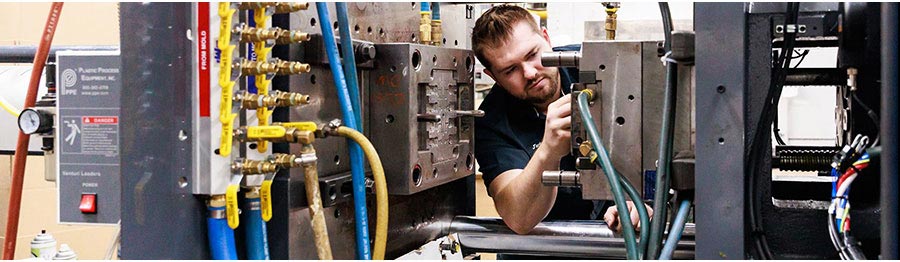
Action Plastics molds parts for a variety of industries, primarily in the power sports, medical, and food and beverage sectors. Photo courtesy Action Plastics Inc.
While researching collaborative robots, the Action Plastics team attended a manufacturing trade show in Chicago, where they discovered Productive Robotics. At the show, they got a live demo of the company’s OB7 seven-axis cobot. Within minutes, they learned how to move the robot and teach it basic tasks. Seeing how flexible, smooth and user-friendly it was, the team determined that the cobot was ideal for their operation.
Back in Rogers, shop-floor personnel were involved with the cobot from the moment it was uncrated. After going through a few trial runs, playing around with the cobot, and seeing that it would work safely alongside them, employees gained trust in OB7 and its capabilities.
“Many were a little standoffish and not sure what to think at first,” shares Tad Orstad, director of operations at Action Plastics. “But, as we started to roll it out and see it do new jobs, they became more excited about what it can do. Now, employees come to us with new ideas and opportunities to do jobs that are boring or repetitive.”
Looking for quick answers on assembly and manufacturing topics? Try Ask ASM, our new smart AI search tool. Ask ASM
Setting up OB7 out of the box was straightforward. OB7’s “no programming” interface makes teaching jobs simple and fast. Engineers also designed their own custom table to set up jobs. Now, changeover between jobs takes only a couple of minutes.
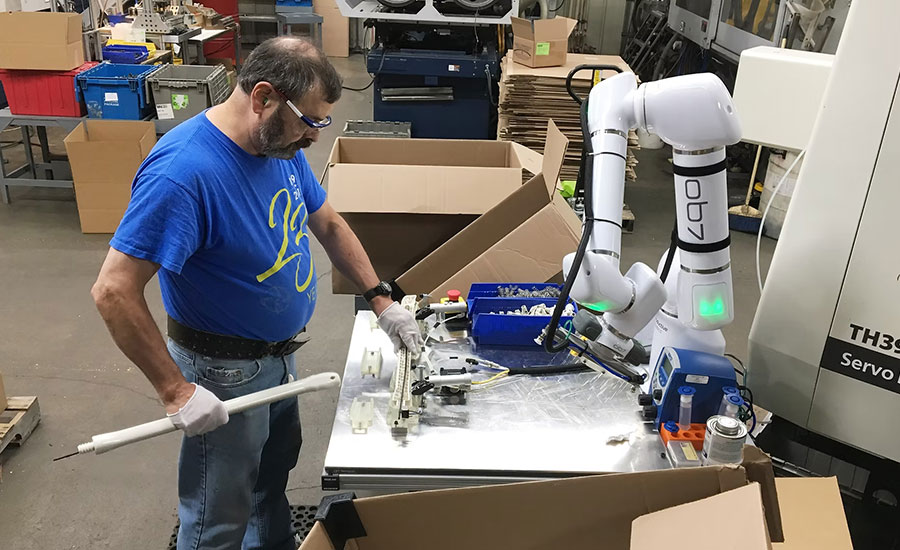
By automating the dispensing and assembly processes with a cobot, Action Plastics successfully addressed its customer’s quality issues. Photo courtesy Productive Robotics
Dispensing, Assembly and Quality Control
One of Action Plastics’ customers makes a novel household plumbing tool: a combination plunger and drain snake.
Initially, the customer handled assembly of the product after it was molded, but it faced quality issues in the adhesive dispensing and final assembly processes. Adhesive would often get into inner locations of the tool, bonding components that shouldn’t be bonded. In addition, finished assemblies would be rejected due to excessive adhesive, embedded fingerprints on finished surfaces, and insufficient adhesive in the many lip and pin joints.
Engineers at Action Plastics thought they could solve those problems by taking on the assembly process and using the OB7 to automate the dispensing process at the molding press.
Shortly after, they discovered that the OB7 could automate other processes within the job to save even more time, increase efficiency, and optimize productivity.
“The flexibility really showed when we got the OB7, set it up, and started playing around with it. Our initial idea quickly evolved, and we ended up using the OB7 for something else—a new, turnkey system, actually,” explains Orstad.
The OB7 dispenses adhesive into the lip joint and 12 pin-joint bosses on the interior of the product. Sensors were installed into fixtures to ensure the internal components were properly located and aligned prior to dispensing. The cobot provides consistent positioning and precise dispensing at each location. The cobot also performs final assembly of the product by bringing the two halves of the product together using a vacuum pump and suction cup on the end of the arm.
Thanks to the OB7’s flexibility and seven-axis maneuverability, engineers were able to teach it to automate several processes for one job. This freed up a worker to focus on critical molding processes.
Automating these processes with OB7 allowed Action Plastics to successfully address its customer’s quality issues. In the end, Action Plastics was able to provide the customer with a finished product at a much more competitive price than could have been achieved with other methods.

Action Plastics increased productivity by automating mid-volume assembly and production processes that depended on manual labor. Photo courtesy Productive Robotics
Inspection and Packaging for a Medical Application
Action Plastics saw another opportunity for the OB7 in a medical application for a translucent filter housing. This process required an operator to visually inspect every filter, checking for bubbles or impurities within the molded component. Running three shifts five days a week, there were inherently inconsistencies from worker to worker and shift to shift.
To address this, Action Plastics used the cobot to automate the process for consistency. By pairing the cobot with an infeed conveyor and a vision system, OB7 did the visual inspection and final packaging.
The cobot picks up a part from the conveyor, which is tied to a molding press. It then places the part onto a turntable. As the turntable rotates, a vision system rapidly inspects the part in six orientations. At the end of the inspection process, the cobot places the part into finished goods packaging or a nonconforming bin.
Using the cobot to automate the inspection and packaging process allowed Action Plastics to increase consistency and throughput and redeploy the worker to a more skilled job.
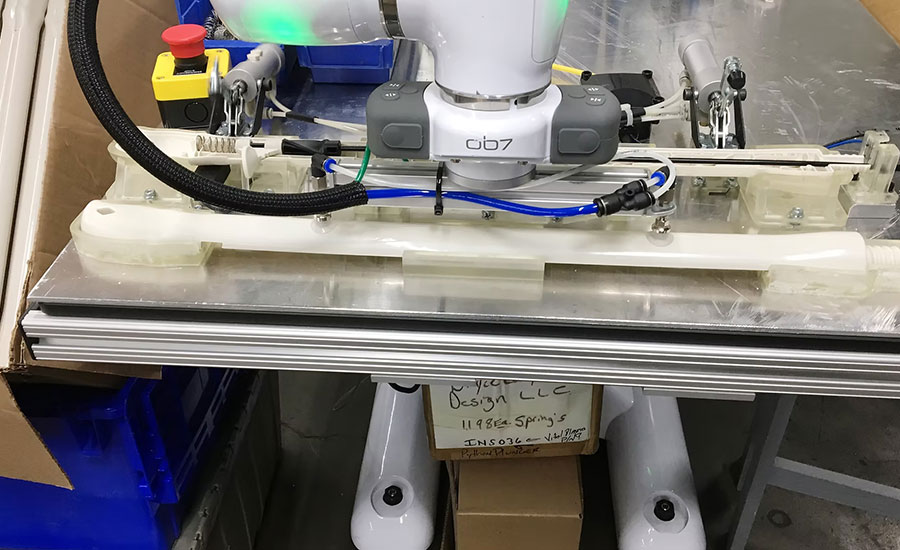
A vacuum gripper enables this cobot to assemble the plastic handle for a plumbing product. Photo courtesy Productive Robotics
Material Handling and Process Control
Action Plastics has found other ways to use the cobot to handle time sensitive operations. In one application, for a touch-free hand soap dispenser, parts are produced with a short cycle time in a mold with a high number of cavities. The parts then go through a cooling water bath to chill. Historically, a worker would perform the cooling and transfer process.
Now, Action Plastics uses the cobot to automate the material handling and send the parts through the water bath. As a result, the worker no longer has to handle parts in the water tanks. Instead, he can focus on other, more critical tasks associated with this complex and tight tolerance component.
The Future: A Dynamic Workforce
Action Plastics is using cobots to create a more dynamic workplace. Freeing up workers from monotonous tasks opened the door to more cross-training and flexibility in production. Operators can now go beyond the restrictions of a particular job or a range of jobs and focus on other jobs that require more skill and knowledge.
“We see areas where we are either struggling quality-wise or in retaining talented team members because some jobs are quite monotonous, or in some cases really hot or noisy. It allows us to put operators in more challenging jobs and build their skill sets,” says Orstad.
Looking ahead, Action Plastics has plans for the OB7 to handle other repetitive tasks, such as packaging, kitting, and processes that do not require connecting to outside equipment. They also see potential for machine tending with their injection molding presses to handle opening and closing doors and pulling parts from the mold.
For more information on cobots, visit www.productiverobotics.com.
For more information on cobots, read these articles:
Picking the Low-Hanging Fruit
Cobot Boosts Output by 33 Percent
Cobot Installs Screws in Electronic Assemblies
Looking for a reprint of this article?
From high-res PDFs to custom plaques, order your copy today!