Assembly Magazine logo
search
Ask ASSEMBLY AI
cart
facebook twitter linkedin youtube
  • Sign In
  • Create Account
  • Sign Out
  • My Account
Assembly Magazine logo
  • TRENDS
    • Ask ASSEMBLY AI
    • Trends
    • News
    • New Products
  • INDUSTRIES
    • Aerospace
    • Appliance
    • DFMA Assembly
    • Medical Devices
    • Green Manufacturing
    • Lean Manufacturing
    • Machinery Assembly
    • Electronics Assembly
    • Automotive
  • TECHNOLOGIES
    • Adhesives & Dispensing
    • Assembly Presses
    • Automated Assembly Systems
    • Manufacturing Management
    • Manufacturing Software
    • Motion Control
    • Screwdriving & Riveting
    • Robotics
    • Test & Inspection
    • Plastics & Metal Welding
    • Wire Processing
    • Workstations
  • AUTONOMOUS & ELECTRIC MOBILITY
    • AEM Magazine Archives
    • Autonomy
    • Electrification
    • Mobility Services
    • Assembly & Testing
    • AV/EM News
  • MEDIA
    • Ask ASSEMBLY AI
    • Podcasts
    • Assembly News Now
    • Assembly TV
    • Webinars
    • eBooks
  • EVENTS
    • Calendar
    • The ASSEMBLY Show
  • MORE
    • Exclusives >
      • Plant of the Year
      • Capital Spending
    • Buyers Guide >
      • Supplier Insights
    • Classifieds
    • Featured Products
    • Newsletters
    • Store
    • White Papers
    • Columns
    • Sponsor Insights
  • INFOCENTER
    • Assembly & Test Solutions
  • EMAGAZINE
    • eMagazine
    • Archive Issues
    • Advertise
    • Contact Us
    • Sign Up
Aerospace AssemblyElectronics AssemblyRobotics AssemblyTest and Inspection Assembly

Automated Assembly

Cobot Automates Avionics Testing Process

Force-controlled grippers enable cobot to safely load and unload sensitive electronic assemblies
By John Sprovieri
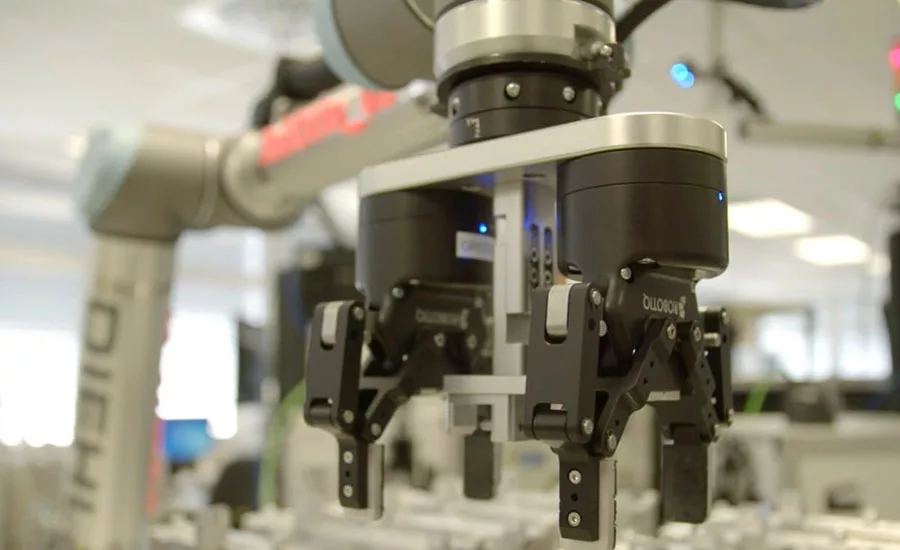
Robotic gripper mounted on a collaborative robot arm in a manufacturing setting.
Photo courtesy Robotiq

A cobot equipped with a pair of grippers loads and unloads avionics from an automated test cell.

June 18, 2026

The skies are crowded these days. Despite rising costs, people are flying.

According to the International Air Transport Association, the global trade association for airlines, the world’s carriers will fly more than 5.2 billion passengers on 40.3 million flights in 2026. Compared with 2022, that’s a 50 percent increase in passengers and a 37 percent increase in flights.

That’s good news and bad news for aerospace OEMs and their suppliers. While higher sales are certainly welcome, the pressure to deliver more airplanes—and faster—is intense.

One supplier feeling the heat is Diehl Aviation. Based in Laupheim, Germany, Diehl is a Tier 1 supplier for most of the world’s civilian and military OEMs, including Airbus, Boeing, Bombardier, Embraer and Gulfstream. The company’s products include aircraft interiors and ducting; cabin modules, such as lavatories and galleys; water systems and fire protection technologies; lighting; cabin management systems; flight control technologies; and modular avionics.
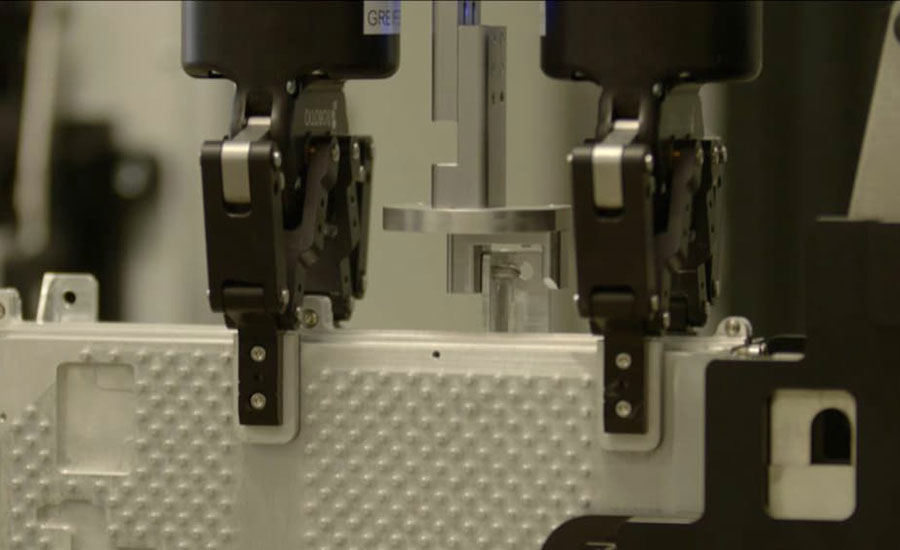
Robotic grippers handling a component during an automated manufacturing process.

Gripping force is adjustable to avoid damaging the assembly’s aluminum housing and the electronics within. Photo courtesy Robotiq

The family-owned business employs more than 5,200 people at nearly two dozen locations worldwide, including the United States, France, China, Hungary and Mexico.

Diehl’s factory in Überlingen, Germany, is where the company assembles computers and electronics for civilian and military aircraft. Among other products, the factory assembles the computer systems for the Airbus A350 XWB, one of the world’s best-selling passenger jets.

With orders for this aircraft in full swing, Diehl’s quality testing department needed to increase capacity quickly. To keep up with demand, Heiko Russ, head of industrial process engineering at Diehl, had two options: add a night shift or automate.

Looking for quick answers on assembly and manufacturing topics? Try Ask ASM, our new smart AI search tool. Ask ASM →

The choice was clear. “At first, we thought about using traditional industrial automation technology,” says Russ. “But, after various visits to fairs and extensive research, we realized a collaborative robot would be the best option, since it’s a lot more flexible and easy to use.”

Automating Elaborate Test Procedures

Each computer for the Airbus 350 XWB undergoes two hours of rigorous testing, during which every electrical interface, input, output and sensor is double-checked. Although the tests are carried out by an automated system, workers loaded and unloaded the computers manually.

The staff of KPI Engineering, which helped Diehl with the design, integration and operation of the test system, recommended Robotiq and Universal Robots for the task of inserting the computer into the test instrument.

“These computers are fragile, and they weigh 4 kilograms with an asymmetric center of gravity,” explains Marvin Plantius, CEO of KPI Engineering. “We were looking for equipment with adjustable force to avoid damaging the aluminum housing and electronics within. We also needed highly repeatable accuracy despite the 4-kilogram payload.”
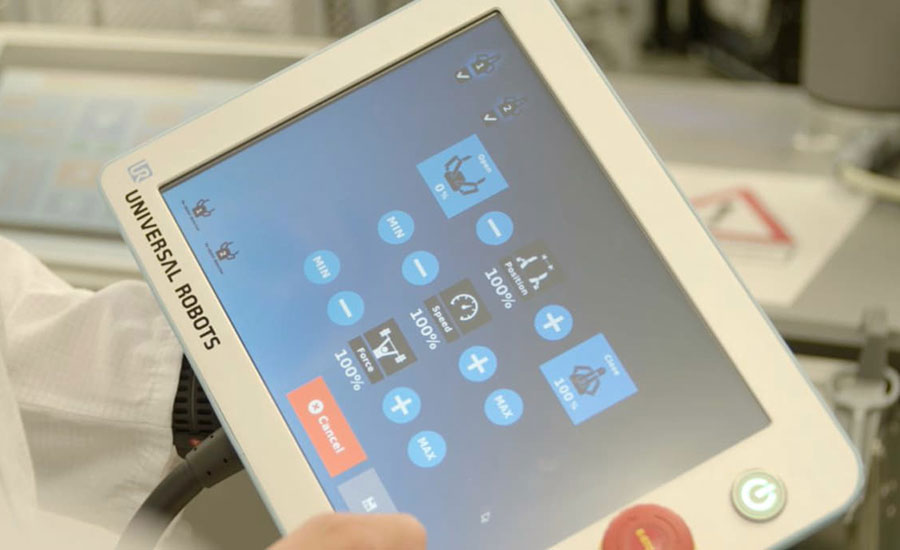
Touchscreen control panel used to operate a collaborative robot system.

The gripper is programmed through the robot’s teach pendant. Photo courtesy Robotiq

KPI chose a pair of Robotiq 2F-85 adaptive two-finger grippers and a FT 300 force-and-torque sensor to handle the computer case.

The 2F-85 is adaptable and versatile. Stroke, speed and force are programmable. Maximum stroke length is 85 millimeters, and it can produce a grip force of 20 to 235 newtons. Designed to pick up a range of objects, the device allows for both encompassing and pinch grips. Replaceable fingertips enable engineers to match the gripper to the part. The gripper can carry a maximum payload of 5 kilograms.

“We needed a very flexible gripper with which we could easily monitor force and the distance between two points,” says Plantius. “The 2F-85 was an obvious choice. The big advantage of the force-and-torque sensor is that you can record complex movements with the path-recording function. Force can be monitored for critical movements, such as when components contact the parts trays.”

Diehl chose a Universal Robots UR10 six-axis cobot, which has a load capacity of 10 kilograms and a reach of 1,300 millimeters, for the project. It was the first time a cobot had been deployed at the Überlingen factory.

“It matched the environment really well,” says Plantius. “We wanted a cell design that takes very little space in an open area. We established a safety perimeter with sensors that slow down or stop the robot when a human is detected within a specific distance from the robot. This is a great alternative to caging, and it meets the highest safety standards. Plus, the components from Robotiq are UR+ certified, which simplifies integration with Universal Robots. They are coordinated in terms of hardware and software, which allows us to operate the grippers and force sensor directly via the controller.”
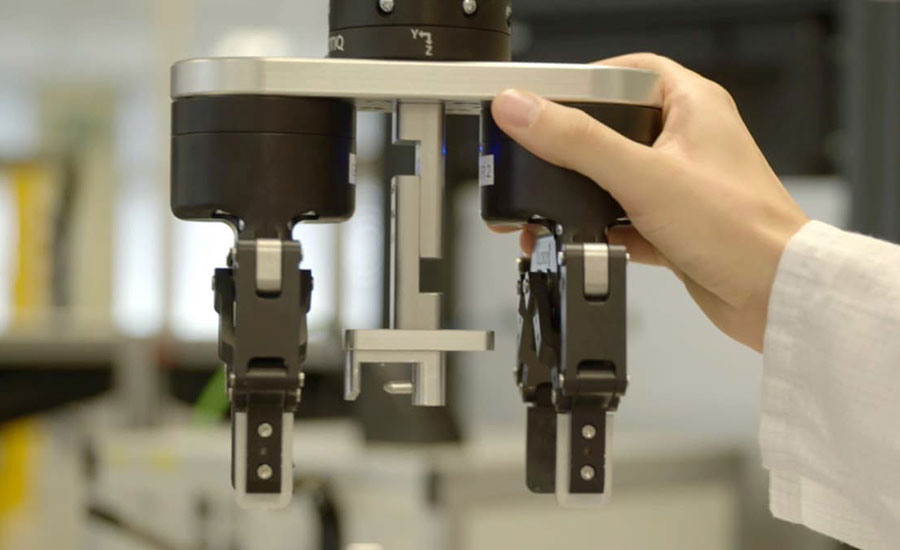
Hand adjusting a robotic gripper on a collaborative robot system.

Designed to pick up a range of objects, the gripper can perform both encompassing and pinch grips. Replaceable fingertips enable engineers to match the gripper to the part. Photo courtesy Robotiq

Complex Application, Easy Programming

The testing application is controlled by a human-machine interface, independent from the Universal Robots teach pendant. The robot first receives the signal to retrieve a computer with both grippers. Prior to inserting the computer into the tester, the robot takes it to a scanner, which reads a bar code.

Once this operation is done, the computer is placed in the testing unit. The pair of grippers ensures that the computer is placed in the tester in the exact same position every time. The robot then closes a lever, and the testing phase starts. After testing is complete, the robot unloads the computer, and the process repeats.

Although there are many steps for this application, employees affected by the testing unit learned how to work with the new technology quickly.

“In the beginning, two of our employees completed online training,” says Daniel Frei, industrial production manager at Diehl. “One of them attended the core training course at Universal Robots in Munich, which provided much more insight on the matter: How do I program the robot? How do I install every component? And so on. Afterward, they came back to Überlingen and taught five more people in the factory.”

Person inspecting a manufactured component through an assembly structure.

Diehl’s include aircraft interiors and ducting. Photo courtesy Diehl Aviation

Appreciating Automation

Diehl management quickly informed the whole staff that a robot was coming into the factory. “There were a few worries about job losses, but since this was a way to scale up, and an addition to the team rather than a job threat, it soon came to be seen as good news in a growth context,” explains Russ. “It also meant the end of extra night and weekend shifts, which nobody enjoyed doing.”

“We earned an ROI within a year by putting an end to night shifts,” adds Rolf Metzner, head of industrial engineering at Diehl. “With the addition of excellent teamwork and communication, we’ve got everything we need to plan for the future.”

The project’s success has Russ thinking about future automation projects. “We have paved the way for many more robotics projects. Our colleagues are looking at what we do and taking notes,” he says. “We now have a working group dedicated to robotics here. They are analyzing different arms for other heavier applications. As for our team, we’re thinking of replicating this testing cell with our Airbus A320 computers.”

For more information on collaborative robots, visit www.universal-robots.com. For more information on grippers, visit https://robotiq.com.

KEYWORDS: factory automation flexible assembly robot grippers robotic machine tending

Share This Story

Looking for a reprint of this article?
From high-res PDFs to custom plaques, order your copy today!

John has been with ASSEMBLY magazine since February 1997. John was formerly with a national medical news magazine, and has written for Pathology Today and the Green Bay Press-Gazette. John holds a B.A. in journalism from Northwestern University, Medill School of Journalism.

Recommended Content

JOIN TODAY
To unlock your recommendations.

Already have an account? Sign In

  • Made in the U.S.A.

    Consumer Products Manufacturing: Made in the USA

    Supply chain lessons learned during the coronavirus...
    Automated Assembly Systems
    By: Austin Weber
  • Best Practices for Press-Fit Assembly

    Best Practices for Press-Fit Assembly

    In manufacturing, ironclad formulas for success are hard...
    Assembly Presses
    By: Jim Camillo
  • aem0523leader-tesla1.jpg

    Tesla Rethinks the Assembly Line

    Engineers at Tesla Inc. have developed a new process that...
    Assembly and Testing
    By: Austin Weber
Manage My Account
  • eMagazine Subscription
  • Assembly Newsletters
  • Online Registration
  • Subscription Customer Service
  • Manage My Preferences

More Videos

Sponsored Content

Sponsored Content is a special paid section where industry companies provide high quality, objective, non-commercial content around topics of interest to the ASSEMBLY audience. All Sponsored Content is supplied by the advertising company and any opinions expressed in this article are those of the author and not necessarily reflect the views of ASSEMBLY or its parent company, BNP Media. Interested in participating in our Sponsored Content section? Contact your local rep!

close
  • ultrasonic welding
    Sponsored bySonobond Ultrasonics

    Engineering Efficiency in High-Performance Assembly: How Ultrasonic Welding Enhances Throughput, Reliability and Quality

  • UV curing system
    Sponsored byDymax

    Why UV Intensity Alone Doesn’t Define Curing Performance

  • wooden pallets
    Sponsored byLEAN Manufacturing Products

    Eliminating Waste on the Shop Floor: Applying Lean Principles to Improve Manufacturing Efficiency

Popular Stories

Ferrari

Ferrari Unveils Four-Door EV

ASSEMBLY News Now, episode-30: Volvo Redesigns EV Manufacturing

Volvo Redesigns EV Manufacturing

workstation

Knife Maker Redesigns Assembly Line

Watch the latest episode of ANN now!

Events

July 24, 2025

From Shop Floor to CFO: How Manufacturers Are Closing the Loop Between Operations and Finance

On Demand Learn how manufacturers are bridging the gap between the shop floor and ERP systems to gain real-time visibility, streamline operations, and kick-start digital transformation—without waiting years.

Sponsored by:

PicoStratusGreen
July 30, 2025

Buffer Analysis and Design Fundamentals for Manufacturing Excellence

On Demand In this presentation, Dr. Herman Tang shares practical insights from his industry experience and research on buffer management in manufacturing operations.

View All Submit An Event

Poll

Difficult Assembly Processes

Which assembly process gives you the most difficulty?
View Results Poll Archive

Products

Manufacturing Cost Policy Deployment (MCPD) Profitability Scenarios: Systematic and Systemic Improvement of Manufacturing Costs

Manufacturing Cost Policy Deployment (MCPD) Profitability Scenarios: Systematic and Systemic Improvement of Manufacturing Costs

See More Products
ebook

Related Articles

  • installing screws onto a cover panel of a network antenna

    Cobot Automates Screwdriving at Electronics Company

    See More
  • cobot for machine tending

    Cobot Automates Machine Tending

    See More
  • Establishing Control of the Harness Testing Process

    See More

Related Products

See More Products
  • characterization.jpg

    Characterization, Testing, Measurement, and Metrology

  • testing.jpg

    Testing Complex and Embedded Systems

  • Testing Adhesive Joints: Best Practices

See More Products

Related Directories

  • DB Cobots

    DB Cobots is a United States based master distributor of Dobot Industrial Collaborative Robots. We stock all models of Dobot Cobots and accessories and provide technical support, service and training. Desktop 4 axis priced at $2,890. 6 Axis Cobot models starting at $19,790. Payloads to 20KG.
  • PrimeTest Automation

    PrimeTest Automation is a manufacturer of custom assembly, process, and test automation systems for manufacturing facilities. We are a full-service systems integration company with a talented in-house engineering team featuring mechanical, electrical, and software engineers. All systems are modeled using the latest in 3D design software, thoroughly reviewed with the customer, and manufactured in our facility located in Fort Lauderdale, Florida.
  • ZELTWANGER Leak Testing & Automation

    ZELTWANGER is a technology leader and pioneer in leak testing - covering modern instruments, devices, tooling and turnkey automation machinery. We use air, helium or other tracing gases to detect leaks on products, and apply all modern techniques with pressure or vacuum, as well as various mass flow, pressure and differential pressure decay methods. Applications range from batteries, fuel cells and antomotive components, all the way to medical, life science or general industry parts. We have couple locations in North America and laboratories for try-outs and validation.
×

Never miss the latest news and trends driving the manufacturing industry

Stay in the know on the latest assembly trends.

JOIN TODAY!
  • RESOURCES
    • Advertise
    • Contact Us
    • Directories
    • Manufacturing Division
    • Store
    • Want More?
  • SIGN UP TODAY
    • Create Account
    • eMagazine
    • Newsletters
    • Customer Service
    • Manage Preferences
  • SERVICES
    • Marketing Services
    • Reprints
    • Market Research
    • List Rental
    • Survey/Respondent Access
  • STAY CONNECTED
    • LinkedIn
    • Facebook
    • Instagram
    • YouTube
    • X (Twitter)
  • PRIVACY
    • PRIVACY POLICY
    • TERMS & CONDITIONS
    • DO NOT SELL MY PERSONAL INFORMATION
    • PRIVACY REQUEST
    • ACCESSIBILITY

Copyright ©2026. All Rights Reserved BNP Media, Inc. and BNP Media II, LLC.

Design, CMS, Hosting & Web Development :: ePublishing