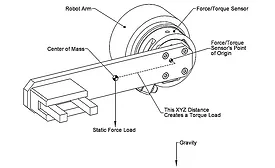
Robots have always struggled to match human touch. But, recent advances in sensor technology now enable machines to process the sensitive forces needed for delicate assembly tasks, such as placing, inserting and tightening parts.
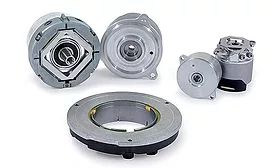
Speed, power and durability are key characteristics of industrial robots. These robots are typically used in applications such as welding or in lifting heavy components for vehicle assembly. Yet despite advanced calibration methods, the positional accuracy of industrial robots has been inadequate for certain tasks. This is now changing thanks in part to highly accurate, output-side encoders from Heidenhain and AMO.
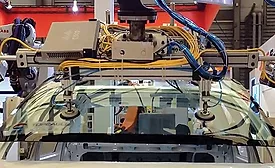
Inserting glass windows into car bodies has been, and remains, a challenge for automotive OEMs. Manual insertion is labor intensive and imprecise, and carries with it the risk of bodily injury to assemblers due to broken glass.
The "father" of the programmable logic controller (PLC), Richard Morley, recently passed away at age 84. After he invented the device 50 years ago, it revolutionized plant floors around the world. The PLC eliminated the need for hard wiring and spurred the development of flexible manufacturing.
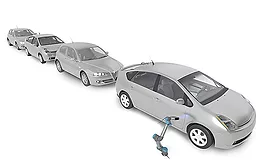
Robots are being used for a variety of assembly and inspection applications, which is enabling the operation of lean, efficient and automated systems where more than one product type or model can be produced on a single assembly line.
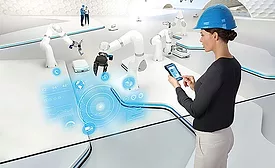
Robots are increasingly being made to mirror humans. The best example of this is the dual-armed robot—such as ABB’s YuMi and Rethink Robotics’ Baxter—designed specifically to work closely with people on the assembly line.
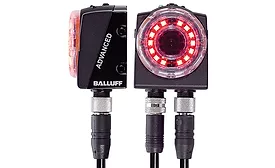
Vision systems play a vital role in automated assembly systems. They can check for the presence or absence of parts or materials. They can measure key dimensions of assemblies. They can tell robots the precise location of parts. They can even read 1D and 2D codes.
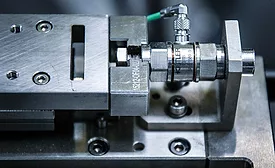
Whether fully automatic, semiautomatic or manual, almost every assembly system has some type of sensor for inspection, error-proofing or production monitoring. Thanks to new technologies, sensors are becoming smaller, more robust, more accurate and easier to integrate.