Test and Inspection
New Tech Checks EV Batteries for Leaks
New technology enables an integrator to transition from leak-testing air bag inflators to inspecting EV batteries.
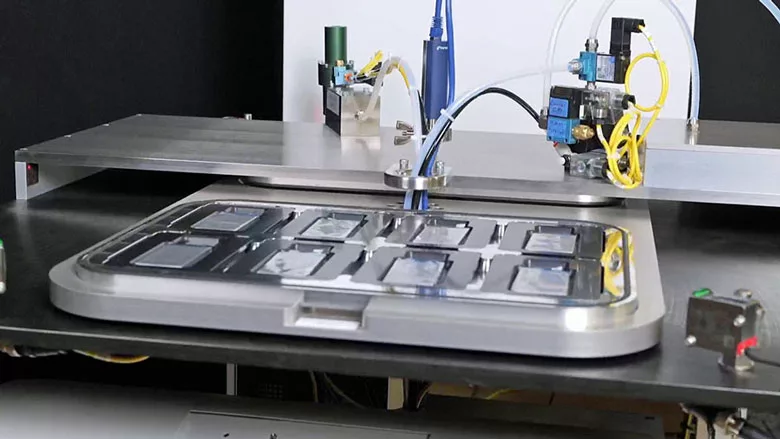
The test system has a rotating fixture, so eight parts can be loaded and unloaded while another eight are being tested.
Spectro Physics Inc. was established in 2003 to design and build automated systems for leak-testing automotive assemblies—primarily air bag inflators. These devices came under scrutiny decades ago due to injuries and deaths directly attributable to insufficient leak testing by some inflator manufacturers. Spectro Physics helped to ensure the safety of these devices by developing sophisticated leak-testing systems.
Along the way, Spectro Physics learned the value of using leak-testing devices capable of repeatability, calibration accuracy and consistency. Their original devices, while useful, didn’t measure up.
“When the Inficon LDS3000 came out, it was just better. I’m constantly amazed at how well it reads—how consistently and accurately it reads and maintains accuracy between calibration,” says Dwane Williams, Spectro Physics’ owner. “We have had overwhelming success.”

The original Inficon ELT3000 leak test instrument was designed with R&D in mind, not line-speed applications, which is why the company developed the ELT VMax system. This newer system offers the fastest line-speed test system in the industry. Photo courtesy Inficon
Spectra Physics integrated the LDS3000 into leak-testing systems designed for testing small, critical parts, like air bag inflators. Spectra’s systems are designed to provide traceability. They can transfer data electronically, read bar codes, “and attach all kinds of test information to send back to a host system,” Williams says.
Recently, a manufacturer of pouch-style batteries for EVs approached Spectro Physics to see if the company could help test its products. “We were asked to look at battery [leak] detection, knowing that it’s a different process,” Williams explains.
Although all leak-testing processes might seem similar, the differences between tests on batteries and inflators are profound. The process requires a leak detector that works quite differently.
Helium Bombing
Air bag inflators contain high-pressure gases that are released upon a vehicle impact. To check them for leaks, inflators are often exposed to high-pressure helium gas—a technique called “bombing”—then removed from that environment and placed into a vacuum chamber where any helium that had migrated into the inflator can then migrate out for rapid detection.
Looking for quick answers on assembly and manufacturing topics? Try Ask ASM, our new smart AI search tool. Ask ASM
The process of testing EV batteries is similar, but different.
Battery cells contain a liquid lithium-ion electrolyte that operates at atmospheric pressure. Batteries, regardless of the type, are more fragile, though hard-sided batteries like cylindrical and prismatic, or box-type, cells are more robust than flexible pouch cells.
Inficon had done significant work with battery testing, having analyzed the chemistry and found components that were easy to isolate.
“Inficon’s engineers looked at the pressures at which different components of the batteries began to vaporize and knew what test pressures were best,” Williams says, “all of which was critical to exploring leak detection for pouch cells.”
Inficon loaned Spectro Physics its new ELT3000 leak detector to see if it would work with the new application. “It was quite a different animal than our LDS3000, which uses helium for its leak test medium,” Williams adds.
“I don’t think the customers knew what to ask yet,” recalls Williams, noting that this is a familiar issue for customers struggling with leak-detection concepts. “It’s sometimes hard for people to wrap their heads around the minute size of a problem leak. What we see is customers understanding in a general sense their need for leak detection. They say, ‘My product needs to be quality tested so I don’t have issues down the road,’ but as far as pinning down exactly what leak testing their product may need, they say, ‘I don’t know that we have a good understanding.’”
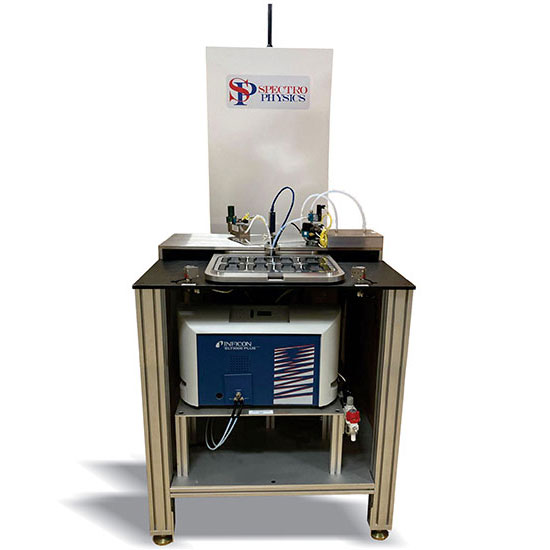
Checking for leaks at the cell level is important. The ingress of gases—specifically oxygen and water vapor—accelerates cell failure. Photo courtesy Inficon
With EVs, individual battery cells are aggregated into modules, and the modules are then assembled into a pack. Each part of the system—cell, module and pack—gets checked for leaks.
Checking for leaks at the cell level is particularly important. The ingress of gases—specifically oxygen and water vapor—accelerates cell failure. Oxygen ingress can increase formation of dendrites, and water vapor interacts with many electrolytes to cause acid formation.
Although leak-tightness standards for multi-cell battery packs are well-known, leak tightness for individual cells is not as well understood. SAE International has addressed the former by issuing J-3277, a leak specification for battery packs and is now working on one for battery cells of all types.
“When you look at the cost of leak testing your parts—and you contrast it against warranty costs, safety and reputational damage—the benefit is clear,” says Greg Hill, calibration lab manager at Spectro Physics. “When you package reliable leak detection with an automation system, [catching just one faulty battery] pays for that testing multiple times over.”
“It was quite different to test pouch-cell batteries,” adds Williams. “We had to make sure pressure was not too low. A hard-sided standard battery cell contains a non-gaseous electrolyte that must come through the leak and vaporize before it is detected. Pouch-cell batteries are different. Instead of a stored-gas air bag inflator that may have gas already actively leaking out, pouch cells are different. We can’t just put it into a vacuum chamber, drop the pressure, and look at the signal to see if there’s any helium leaking out of it.
“We must drop it down to pressure and add a short propagation delay for the electrolyte to find its way from the partial vacuum. Assuming a leak, once the electrolyte is out of the battery, then it can vaporize and be detected.”
Equipped with a relatively small vacuum pump that is ideal for laboratory applications, the ELT3000 offered many advantages for high-volume battery testing. “In an industry where throughput is critical, we typically utilize vacuum pumps that evacuate the test chamber in less than a second, which is not possible with the smaller pump,” Williams explains.
His first thought was to rapidly evacuate the test chamber, finding that while the longer draw-down time of the original vacuum pump was “a problem for throughput,” it also was an advantage because as the pressure starts getting below the internal pressure of the part, then long before you’re at a pressure where you can test, you’ve already started the migration of the electrolyte to the outside of the battery. In other words, the long evacuation helped prepare the battery for testing.”
But, Inficon’s new technology eliminated the need for compromise with the smaller, comparatively fragile, pouch cells.
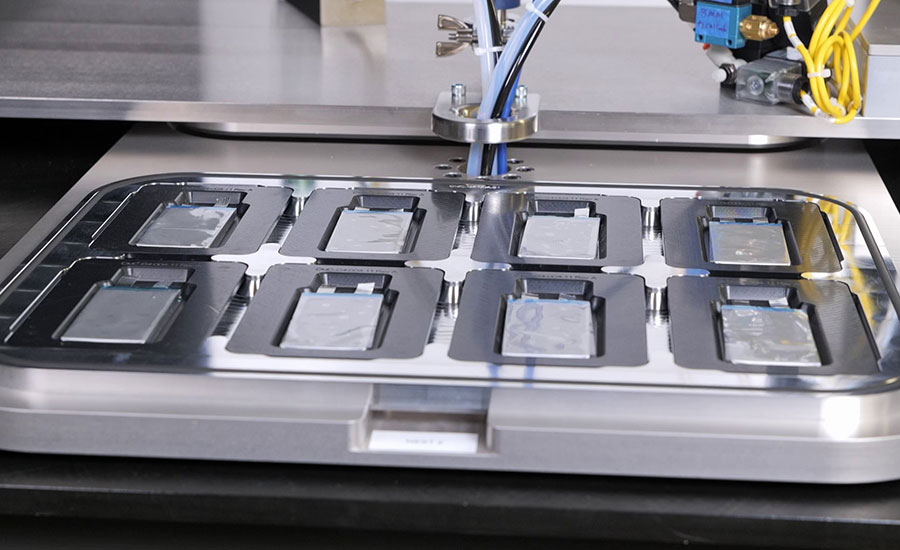
Because eight parts are tested simultaneously, line speed is achieved for a cycle time of 12 to 15 seconds. Photo courtesy Inficon
To achieve throughput requirements, Spectro Physics designed a system that integrated an Inficon ELT3000 to test eight batteries at a time. “These were relatively small batteries, so testing eight of them at a time wasn’t a problem,” Williams explains. “We would load those eight batteries into the test chamber, rotate the test chamber [a two-station clamshell] and then lift it up into position for testing.”
Evacuation to test pressure occurs rapidly, “but we had to hold on to it for a little bit under vacuum to allow the electrolyte to start leaking out.”
Though inherently slow, because eight parts are tested simultaneously, line speed is achieved for a cycle time of 12 to 15 seconds.
“We provide sufficient time to draw the gases that are in the test chamber into the gas detection unit, and it can report and tell us what the leak rate it was able to read. Then we would attach it to the status of the part and come up with a [test result for] the part,” Williams says.
There were challenges, such as electrically pre-charged cells. For this customer, Spectro Physics designed insulated test chambers to prevent shorts. Also, if even one of the eight tested batteries fails, the entire batch must be retested, according to the customer’s specification.
“It’s part of the nature of the beast where we must allow some time for the electrolyte to start leaking out of the battery before we can start detecting it. Because of that, it is never going to be a one-for-one test, like we do in the airbag inflator business,” Williams says.
Based on the success of the pouch-testing system, Spectro Physics anticipates interest from manufacturers of cylindrical cells, which would be “a cakewalk, because they can better handle the vacuum, and it’s easier and more flexible to design the chamber volume,” Williams says.
“These, and other custom-built battery cell leak-testing machines aren’t available off-the-shelf,” he continues. “Our estimation is that if we can get the leak detection hardware and the PLCs, we could deliver an automated leak-testing system as fast as 20 to 26 weeks.”
“But if the need is for a machine that was similar to other machines we had built, testing foil pouches of similar size and throughput requirements, that can be done maybe even as fast as 16 weeks,” Dwane adds.
For more information on leak-test instruments, visit www.inficon.com. For more information on automated leak-testing systems, visit www.spectrophysics.com.
For more information on leak testing, read these articles:
Best Practice Nondestructive Testing for EV Battery Packs, the Equivalent Channel Method
Leak Testing Systems for Battery Cells
Leak Testing Fuel-Related Components
Looking for a reprint of this article?
From high-res PDFs to custom plaques, order your copy today!